Previously unpublished 1998 Lenore Kandel interview unearthed

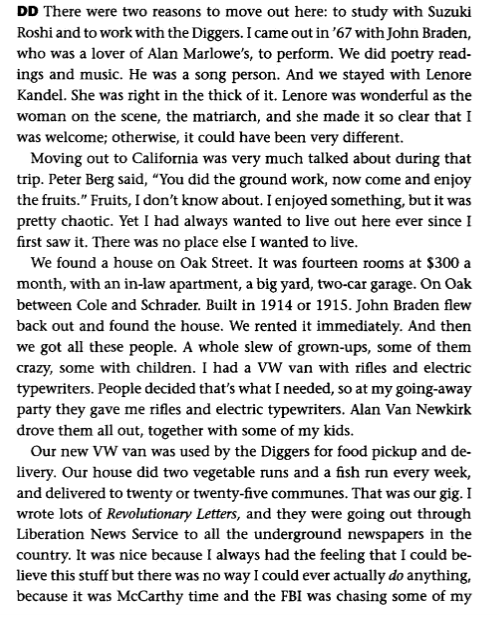
“Come on, get used to it. Loosen up. You must liberate!”: Lenore Kandel (as quoted by Peter Berg in 2006) holding a copy of her Love Book.

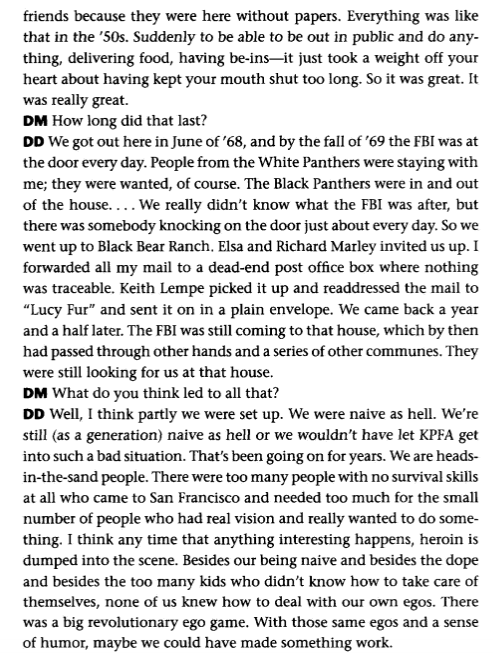
Diggers.org archivist Eric Noble has posted the text of a previously unpublished 1998 interview with Lenore Kandel.

A very small portion of this hour-plus interview, conducted by French filmmakers Alice Gaillard and Céline Deransart, was used in their documentary Les Diggers de San Francisco. The remainder of the conversation has now been transcribed and edited for clarity and is now online. (I helped with some editing.) Go here to read it: https://diggers.org/lenore_kandel.htm

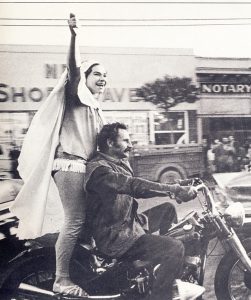
Lenore Kandel was a visionary poet, famed author of the controversial ‘holy erotica’ ‘The Love Book,’ an accomplished belly dancer and folk musician, the only female speaker at the Human Be-In (which occurred on her 35th birthday), and by many accounts, a major, imaginative, persistent force within the Diggers and the Haight scene in general, especially during the crucial 1966-1968 period. (Eric argues that it’s Lenore’s repeated, public use of “Love” that gave the “Love Generation” its name… I don’t know if I’m persuaded on that count [yet], but it’s possible!) She was involved in the early ’60s with Beat poet Lew Welch (they both appear, thinly fictionalized, in Jack Kerouac’s semi-autobiographical 1962 novel, Big Sur); published countless poems in small press magazines, chapbooks and the 1967 Grove Press collection, Word Alchemy (a posthumous 2012 collection of her complete poetic output is in print); appeared with boyfriend/Digger/Hells Angel Bill ‘Sweet William’ Fritsch in Kenneth Anger’s ‘Invocation of My Demon Brother‘; and, along with many other Diggers, was a featured poet at The Band’s ‘The Last Waltz’ concert.

An endearingly gentle-ecstatic Lenore Kandel reads a fresh poem at The Band’s The Last Waltz concert, Nov. 25, 1976.

Untreated injuries resulting from a 1970 motorcycle accident caused Lenore severe pain for the rest of her life; by the ’90s, when this interview was conducted, she was essentially homebound — but, as you will read, she remained intellectually alive, articulate and learned, playful and joyful. There are so many lovely passages in this interview. Yes, I wish Lenore had talked about her own family background, Fritsch, Hells Angels, all the incredible Diggers women, Diane di Prima, Emmett Grogan, Lew Welch, and on and on—but I am so grateful for what is here. 

On a personal note, I had hoped to interview Lenore regarding the Diggers in 2006 with my documentary filmmaking partners; however, when I contacted her, she was in one of her periods when she was feeling unwell. She asked me to call back. In 2009, as my partners and I started to prepare a second trip to northern California to conduct further interviews, Lenore was at the top of our list. Before I called her to try and schedule, I did a quick Google search, and was saddened to learn that she had passed away the previous week.

Everyone that I subsequently interviewed about the Diggers talked about Lenore with great fondness, especially Phyllis Wilner and Vicki Pollack. (Peter Berg and Kent Minault also shared some vivid memories of her brilliance.) Unfortunately, there is almost no record—in print or otherwise—of Lenore herself talking at much length about the Diggers. So, I am especially happy that Alice and Celine shared the unexpurgated footage of their interview with Lenore with Eric—and that he has now made it available to everyone. Love wins.

Field notes, 1966-7

Excerpt from The Human Be-In (Basic Books, 1970) by the brilliant Helen Swick Perry. Perry was 55 in 1966-7 and was employed at the Haight-adjacent Langley-Porter Neuropsychiatric Institute, working on a community mental health project, when she began to explore (and participate in) the goings-on of the “flower children.”


…There was another tool for effecting the psychedelic revolution in the Haight-Ashbury, and this seemed the most effective, the most lasting. For want of a better term, I will call it instant theater; it emerged in the Haight-Ashbury primarily in the phenomenon of the Diggers. In my estimation, much of what the Diggers stood for in the Haight-Ashbury will survive—by word of mouth, by a picture in people’s minds of what they did, by their example of simple kindliness and humanity, by their reaffirmation of the importance of every person and of everyone having his “thing,” and by their emphasis on the destructiveness of property values in a society moving toward technological affluence.

…[T]he living theater of the Diggers as it combined eventually with the wisdom of the black man in the slum represents the significant survival potential of the Haight-Ashbury. Audience participation in theater has, of course, a long and intricate history; and the young people who began the Diggers movement had knowledge of this, as evidenced by their publications and actions. But the instant theater that was developed by the Diggers was more spontaneous and politically sophisticated. This kind of living theater had an immediacy and a communication potential that bypassed the failure of the establishment to listen to the words of the songs sung by the young—even the civil rights songs. All the skill of the medicine man, as the young had witnessed it in the TV ads in their growing-up years, was brought to bear on the audience. The Diggers knew how to make a point without words. They also recognized that a commercial ad would do no good; there must be conviction and dedication, which also had some element of being quite willing to suffer for their beliefs, if that became necessary.

…The Diggers’ drama was a group effort, and it evolved out of the sensitivity of several young artists to a particularly tragic incident in the city; most of these artists were part of the San Francisco Mime Troupe. In the early fall of 1966, San Francisco had experienced a so-called race riot, and the city was upset and puzzled that it could have happened at all. On the afternoon of September 27, three young Negro boys were stopped by a policeman in one of San Francisco’s slums, on the chance that the car they were driving had been stolen; the policeman was correct in his surmise, although his hunch was not based on any report of a stolen car—the owner had not even missed the car by then. The policeman was white, and the boys were understandably scared; they fled, and continued to run after the policeman ordered them to stop. One of the boys, sixteen years old, with the same last name as the policeman but a different shade of skin color, was shot in the back and died almost instantly. Thus began the San Francisco riots of 1966, with three days of “racial turbulence,” as it was described in the Chronicle, and six days of curfew in certain disturbed areas of the city, including the Haight-Ashbury. In the slums of the city—and in this instance this included the Haight-Ashbury, which was not primarily a slum area at all—many people were caught without food because of the curfew and the rioting. Some members of the Mime Troupe, calling themselves Diggers, began to prepare food and serve it free to all comers. There was no formal organization; it was more a state of mind.

The name “Diggers” was somewhat obscurely derived, and different people had different theories about its meaning. Some of the members of the movement clearly connected the name with the Diggers in Cromwell’s England who began to dig and plant the commons in towns throughout the country, distributing free the food produced, as a protest against a government insensitive to the hunger of some of its people. These early Diggers were a branch of the group in England known as the Levellers, who, like the Quaker movement begun in the same general period, had as one of their main tenets the idea of leveling all differences of position or rank among people. At the same time, the word Diggers in the Haight-Ashbury had other connotations, some of them continuous with the Negro culture, for instance, where the term “hip” had long implied that one really “dug” what was happening; and I heard various sympathetic puns on this usage in the Haight-Ashbury coffee houses. There was a free frame of reference for words on Haight Street, as there had been for James Joyce, and it would be restrictive to think that the word Digger meant only one thing in that rapidly changing culture. The use of the word was undoubtedly enhanced by the fact that a North American Indian tribe had once been known as Diggers because they lived chiefly on roots, and Ruth Benedict‘s book Patterns of Culture (1959), which was well read by the young, had as its epigraph a “Proverb of Digger Indians”: “In the beginning God gave to every people a cup of clay, and from this cup they drank their life.” The seekers had an affinity for odd pieces of information floating around which coalesced in remarkable ways from time to time, and they were considerably influenced by the romance and lore of the American Indian. For some of the young people, the name Diggers was connected with grave-digging—a macabre association in light of the young boy’s death. They pointed out that the original Diggers in England had been Levellers, that they had acquired the name Diggers when they had to dig the graves for their own dead on the commons in the morning, after a night’s encounter with the local officials; altruism has always been a peculiarly red flag for the establishment of whatever century or country. At any rate, the word “Diggers” captured the imagination of many people throughout the Bay area, and the concept eventually stirred up as much anxiety in the San Francisco establishment as it did in Cromwell’s England…