How the Deal Really Went Down: Behind the scenes with San Francisco Digger (and counterculture Zelig) HARVEY KORNSPAN

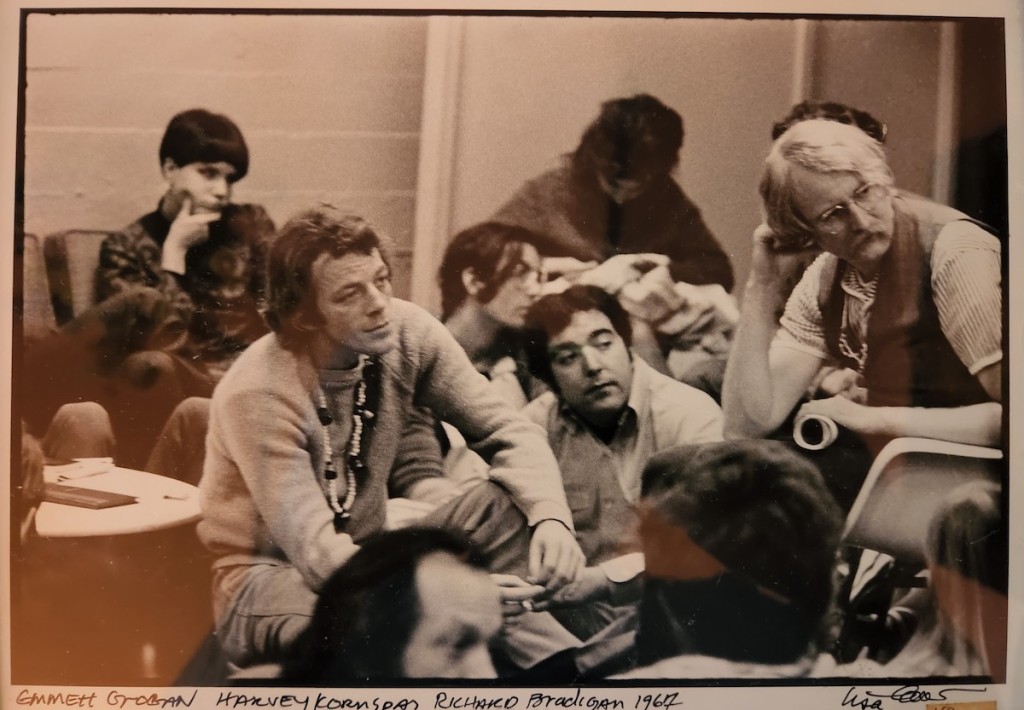
Emmett Grogan, Harvey Kornspan and Richard Brautigan at an Artists Liberation Front meeting, 1967. Photo by Lisa Law, courtesy Harvey Kornspan.

I first interviewed Harvey Kornspan in August, 2010, after I had traveled hundreds of miles to interview many other Diggers in the San Francisco Bay Area, Sacramento and further up the coast, deep in northern California’s Emerald Triangle. This was a bit strange, given that Harvey lives in Silver Lake, less than two miles from the Atwater Village bungalow I was rented until 2008. For years I had been researching the Diggers, and there Harvey was all along, just a hop away.

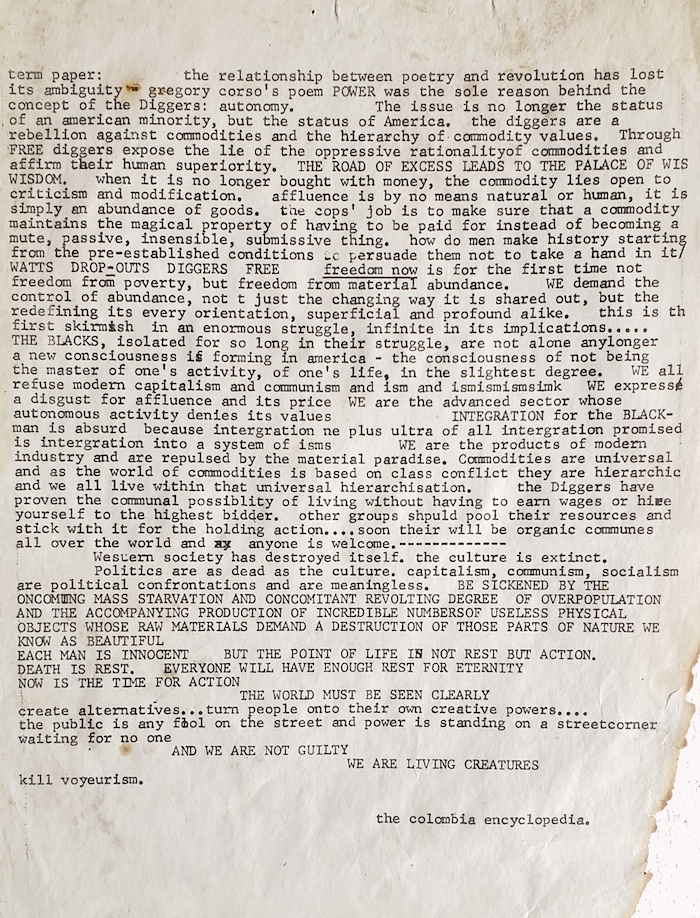
But Harvey was not just a Digger, and he wasn’t just a local. Because unlike every other Digger I’ve ever met or contacted, before or since, Harvey had kept the figurative and literal receipts of the era. So not only did he have his wonderful memories — more of less: it was the ’60s, let’s be reasonable — but he also had unpublished letters, manuscripts, broadside drafts and business documents, as well as a sizable collection of flyers, newspapers, and other ephemera, which he was happy to share. (Some of them are shown here. Harvey is a mensch.)

For the uninitiated: in 2022, yes, the Diggers are little-known. But in 1966-8, such was the Diggers’ presence and notoriety that seemingly every reporter filing a story on the Haight included the Diggers in their account. “A band of hippie do-gooders,” said Time magazine. “A true peace corps,” wrote local daily newspaper columnist (and future Rolling Stone editor) Ralph J. Gleason. The Beatles’ press officer Derek Taylor would later write, “[The Diggers] were in my opinion the core of the whole underground counterculture because they were our conscience.”

So, as the counter-culture came into being, the Diggers were there, the Diggers were important, the Diggers were well-known, but crucially, though they acted in public, the Diggers were anonymous. Nobody knew who they were, where they came from, or how they did what they did. In short, they had a mystique: a group of LSD-fueled street anarchists with a philosophy/practice of “everything is free / do you own thing.”

I recently came across a March 1967 article from the Foghorn, a student newspaper published by the University of San Francisco, a private Jesuit school, that summed up the Diggers vibe succinctly:

The sign on the door said, “You are a digger.” About 50 people had accepted the invitation and moved into the house high in the hills over the Haight-Ashbury.

A cauldron of stew was cooking in the kitchen. The stew, eventually, would be trucked down to the Panhandle, free for anyone with a bowl and a spoon. No one know for sure who brings the food that goes into the stew. Some is donated, some bought, some stolen. The stew would be good today; someone had brought two chickens.

It’s all the work of the Diggers, a mysterious, amorphous group in the Haight-Ashbury dedicated to given things away free and “doing their thing.” They have been evicted from more than half a dozen flats, apartments, and store fronts in the six months of their existence in San Francisco.

One place of refuge is the All Saints Episcopal Church on Waller, where Father Leon Harris has let the Diggers use his church kitchen to prepare the food for the Panhandle for three weeks now.

“The Diggers are industrious, cheerful and benevolent,” he said. “They also give away free clothing and find lodging for homeless people. It seems to me they put a lot of professing Christians to shame by their goodness.”

What follows is a consolidation of various conversations with Harvey, which, to some degree, builds on my previously posted Diggers oral histories, and, as it includes the inside story of why the Altamont disaster happened, offers something of a conclusion. So, many incidents and personages are spoken of without context, or only in passing. My advice to the casual-but-curious reader is to simply let any unfamiliar/unexplained bits pass. Keep reading, you might get something out of the next part.

This is the tenth interview in my series of Diggers’ oral histories; the others are accessible here. For more detailed information on the Diggers, consult Eric Noble’s vast archive at diggers.org  

I have incurred not insignificant expenses in my Diggers research through the years. If you would like to support my work, please make a donation in my PayPal TipJar. All contributions, regardless of size, are greatly appreciated. Thank you!

— Jay Babcock (babcock.jay@gmail.com), July 27, 2022


Jay Babcock: Where’d your grow up?

Harvey Kornspan: I was born in Youngstown, Ohio. My dad sold used cars, had a very successful business. Not rich, middle class. Jewish, both sides. My mom was a homemaker. I have a sister who’s four years older and a brother with Down Syndrome.

Continue reading “How the Deal Really Went Down: Behind the scenes with San Francisco Digger (and counterculture Zelig) HARVEY KORNSPAN”
“We had a far more profound effect on society than we really understood, and some of us paid for that”: An epic conversation with JANE LAPINER and DAVID SIMPSON of the San Francisco Diggers

In 2010, I drove to northern California from my home in Joshua Tree to interview as many living Diggers as would talk to me. Each conversation over those few days felt like a breakthrough—a motherlode of historical detail and insight beyond what I had gleaned from book research. And each Digger I interviewed was excited to learn that I was headed to Humboldt County to interview Jane Lapiner and David Simpson at their forest home. This couple, together since April, 1967, was beloved by other Diggers. If I was interviewing them, it meant that I was really doing my work. Instant Diggers cred.

In 2022, the Diggers are little-known. But in 1966-8, such was the Diggers’ presence and notoriety that seemingly every reporter filing a story on the Haight included the Diggers in their account. “A band of hippie do-gooders,” said Time magazine. “A true peace corps,” wrote local daily newspaper columnist (and future Rolling Stone editor) Ralph J. Gleason. The Beatles’ press officer Derek Taylor would later write, “[The Diggers] were in my opinion the core of the whole underground counterculture because they were our conscience.”

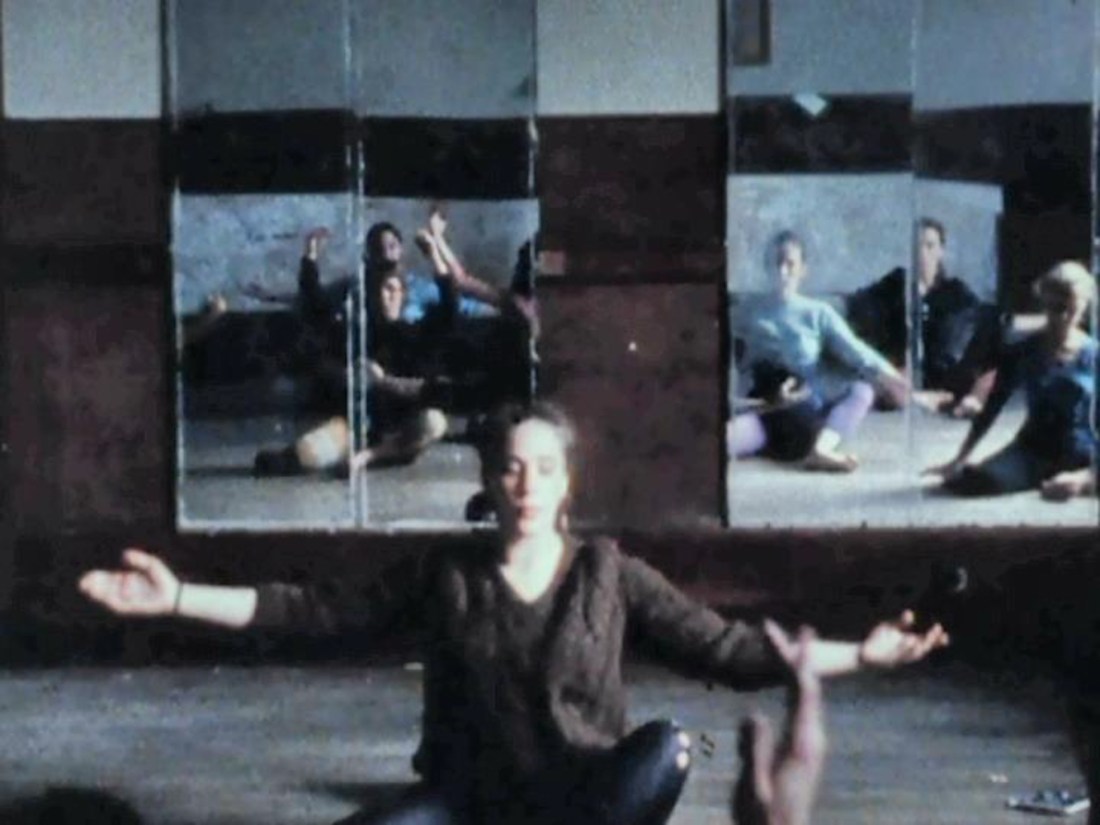
Jane Lapiner and David Simpson were in their mid-20s during the Diggers period. Jane was a single mother from New York City with a background in leftist, avant garde dance; David was a Chicago-bred lefty dropout from the University of Wisconsin, who’d been a competitive boxer in high school, shared a house with pre-stardom Steve Miller and Boz Scaggs, served in the Coast Guard and was trimming trees in the East Bay when… But hold on, I’m telling their stories, instead of letting these award-winning storytellers tell it themselves. 

What follows is a consolidation of conversations the three of us had one night and the next morning inside their farmhouse home, warmed by a wood stove and good food. I am grateful for their hospitality, and the life-example they continue to set (for example, see: “Judge Dismisses Case Against Four Septuagenarian Rainbow Ridge Activists, North Coast Journal, Dec. 15, 2020). There are some ‘60s people who went back to the land and didn’t fail. Jane and David are those people. 

David Simpson and Jane Lapiner at home, 2010. Photo by Bob Doran for North County Journal

Please note that this conversation has not been edited down for a general audience. Many incidents and personages are spoken of without context, or only in passing. My advice to the casual-but-curious reader is to simply let any unfamiliar/unexplained bits pass. Keep reading, you’ll like the next part. You’ll see why these two are so beloved.

This is the ninth interview in my series of Diggers’ oral histories; the others are accessible here. For more information on the Diggers, consult Eric Noble’s vast archive at diggers.org  

I have incurred not insignificant expenses in my Diggers research through the years. If you would like to support my work, you can help out by buying me a cup of coffee or dropping some coins in my paypal TipJar. All donations, regardless of size, are greatly appreciated. Thank you!

— Jay Babcock (babcock.jay@gmail.com), March 5, 2022

Continue reading ““We had a far more profound effect on society than we really understood, and some of us paid for that”: An epic conversation with JANE LAPINER and DAVID SIMPSON of the San Francisco Diggers”

“I lucked out so many times, man”: CLAUDE HAYWARD on his life before, during and after his time with the San Francisco Diggers

ClaudeChesterLAFP
Partners in street print: Claude Hayward and Chester Anderson of the Haight’s Communications Company (com/co), from a March 31, 1967 Los Angeles Free Press profile (courtesy diggers.org)

What a joy it was to find Claude Hayward alive and well and ready to reminisce and think about the San Francisco Diggers back in 2011.

Claude was a shadowy figure in the Diggers — mentioned here and there by name in various accounts and memoirs, famously rendered as mysterious and evasive by Joan Didion (!), the one living guy who could talk in depth about the late Chester Anderson, his partner in printing over 600 broadsides (many of them Diggers-penned) as the Communication Company. Amongst Diggers and children of Diggers, wild stories abounded about Claude’s life before, during and since the Haight. I thought he might be hard to find. But he was right there all along, online, active on Daily Kos and easily reached by email.

I interviewed Claude in a San Francisco backyard on October 2, 2011. We were both in town for the public memorial to the recently departed Peter Berg. I think we were eating apples and drinking coffee. We got a lot of talking done; what follows is pretty much how the conversation went, with some edits for clarity, and some later additions and deletions from Claude.

In 2021, the Diggers are little-known. But in 1966-8, such was the Diggers’ presence and notoriety that seemingly every reporter filing a story on the Haight included the Diggers in their account. “A band of hippie do-gooders,” said Time magazine. “A true peace corps,” wrote local daily newspaper columnist (and future Rolling Stone editor) Ralph J. Gleason. The Beatles’ press officer Derek Taylor would write, “[The Diggers] were in my opinion the core of the whole underground counterculture because they were our conscience.”

This is the eighth interview in my series of Diggers’ oral histories; the others are accessible here. For more information on the Diggers, consult Eric Noble’s vast archive at diggers.org  

I have incurred not insignificant expenses in my Diggers research through the years. If you would like to support my work, please donate via PayPal. All donations, regardless of size, are greatly appreciated. Thank you!

— Jay Babcock (babcock.jay@gmail.com), October 2, 2021

Claude Hayward, 2011.

Jay Babcock: What’s your background? Where did you grow up?

Claude Hayward: My mom’s dad had come over from Germany in 1930; he apparently got a job and made enough money in New York City to bring his family over five years later. Whether he was overtly political or he was just not going to tolerate this crap in Germany and managed to get himself out, I don’t know. He was working class, made stuff with his hands. My mother was born in Germany. She was 9 years old when she got here in 1935. She grew up on Long Island, met my dad at the Grumman Aircraft plant where she and her dad and my dad were all at work building airplanes just before the end of the war. I was born in Brooklyn in 1945.

I lived in Brooklyn in a couple places, then my mother re-married when I was 6 and we lived for part of a year in Greenwich Village, where my stepdad had an apartment. And then we moved out to New Jersey in 1952, some funky place in what’s now called Piscataway, outside of New Brunswick, and I grew up there, that was my boyhood. More country than not—pretty much free to run around, the woods, there were animals to be seen, there was a dairy farmer over the hill and all that. All kinds of Revolutionary War and pre-Revolutionary War ruins and stuff. Apparently Washington camped the Army right there. It was right across the street from Camp Kilmer.

What was your mother doing?

She was being a housewife. I have two half-brothers and a half-sister. They’re younger than I am. My mom took college classes as she could all through her family raising years, and eventually got a degree in English and a teaching credential in German, her native tongue. She was a mighty sharp cookie who somehow managed to impart some lasting values to me.

And your stepfather?

He was a broadcast studio engineer for WABD-TV Television in New York, which was actually the first commercial television station, created by Allen B. Dumont, the engineer who invented the method of mass-producing TV (cathode-ray) tubes that made the explosion of TV into American culture in the early ’50s possible. They were really pioneering stuff. They did Captain Video and Video Rangers live in the studio, 5 o’clock every afternoon. They did other stuff, just taking the camera out into the streets. Nobody had done that. They didn’t know what the fuck they were doing. They were trying to learn how to use this new medium.

So I was six years old and in a fifth-floor walk-up  apartment with a shared toilet in the hall. And I had my own television set! With tubes and a screen about that big. My stepdad was the kind of guy that could monkey around and fix it, he had boxes of tubes and resistors and capacitors and all that.

TV was the beginning of the great homogenization of American culture. That’s all you talked about in school: “Did you see Disneyland last night?” Which meant, did you have a television set? These were black-and-white TVs; color hadn’t gotten there for another couple of years.  I remember hearing schoolmates talking like what they had heard on TV the night before, imitating the mannerisms and idioms of speech.

We got out of there in ’59. My stepdad got a job to build the educational television station at Michigan State. I was there when they did the first live broadcast of a basketball game. Two semi trucks, with gigantic cables going out across the parking lot, the very first video tape recorders. Big Ampeg machines with two-inch tape. He was in at the beginning of all that. And he went on from there. He built the education television station for Santa Monica City College — KCRW — and he also worked in Las Vegas, put together the educational television station there at UNLV. He moved around and managed to get sideways with everybody and had to go find another job. I think the last job he was doing was working out at the Northridge campus in television, teaching people how to do the knobs and stuff.

He ran the radios for a group of tanks crossing France to liberate Europe and God knows what he saw. He never spoke of it. Came out of it bent, but managed to hold it all together long enough for his family to disintegrate around him as the ’60s crashed through. I, of course, had gotten away from that as soon as I could, by mid-’64.

All my family are builders. We learned that you could just do it. My stepdad got a Sears-Roebuck catalog and converted the coal furnace in the basement of the house to an oil-burning furnace by himself, soldering copper parts with a gasoline blowtorch. And what I learned from that was, Well yeah you just do it! There’s no sense of, I can’t do that, or, I’m not qualified. I think that’s got to be the most valuable lesson I ever had.

Continue reading ““I lucked out so many times, man”: CLAUDE HAYWARD on his life before, during and after his time with the San Francisco Diggers”

“The Revolution is the highest kind of fun”: CHESTER ANDERSON on the Diggers and the communication company

ClaudeChesterLAFP
From an Art Kunkin feature on the Haight in the Los Angeles Free Press, March 31, 1967, via diggers.org

Born in 1932, Chester Anderson arrived in the Haight-Ashbury from the East Village sometime in 1966 as a published science fiction novelist, music journalist and post-Beat, gregarious psychedelic counterculture scene veteran. During the Diggers period, he and business partner Claude Hayward ran the “communication company” (aka “com/co”), printing  — and sometimes writing — broadsides submitted to them by Diggers and others, which were then distributed on the street. Chester, who was gay, departed the San Francisco scene sometime in 1967 for reasons not entirely clear, and died in 1991 at age 58. (For more on com/co, see Eric Noble’s diggers.org archive).

Another rare photo of Chester Anderson (second picketer from left), from the Oct. 27, 1967 edition of the Los Angeles Free Press.

But unlike fellow Diggers Emmett Grogan and Peter Coyote, Chester did not — as far as I’m aware — write a memoir about the period. Through the com/co broadsides, contemporary news stories, a few personal letters to friends and various Diggers’ foggy memories, we know something of what Chester did and thought in the Haight in 1966-67. But as to how he later came to regard the period, with the wisdom that usually accrues from the passage of time? We’ve got nothing.

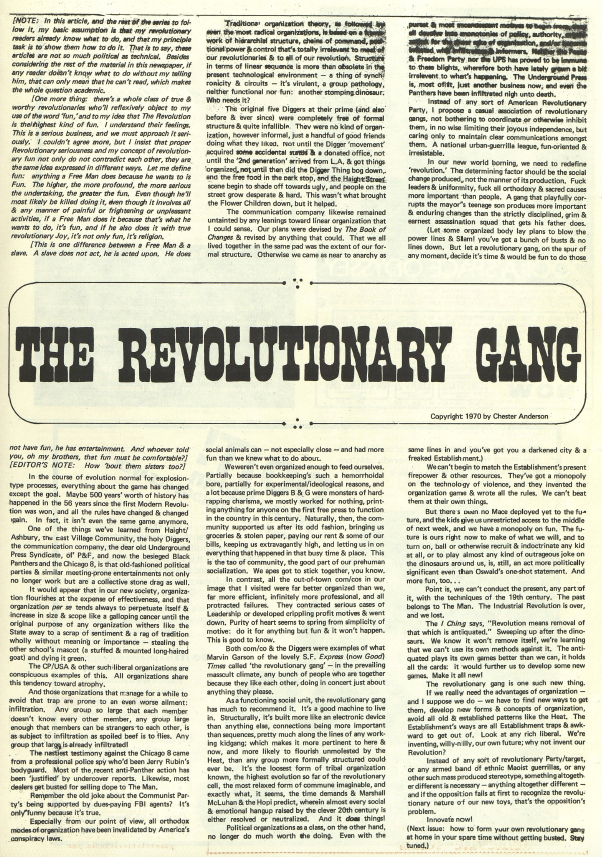
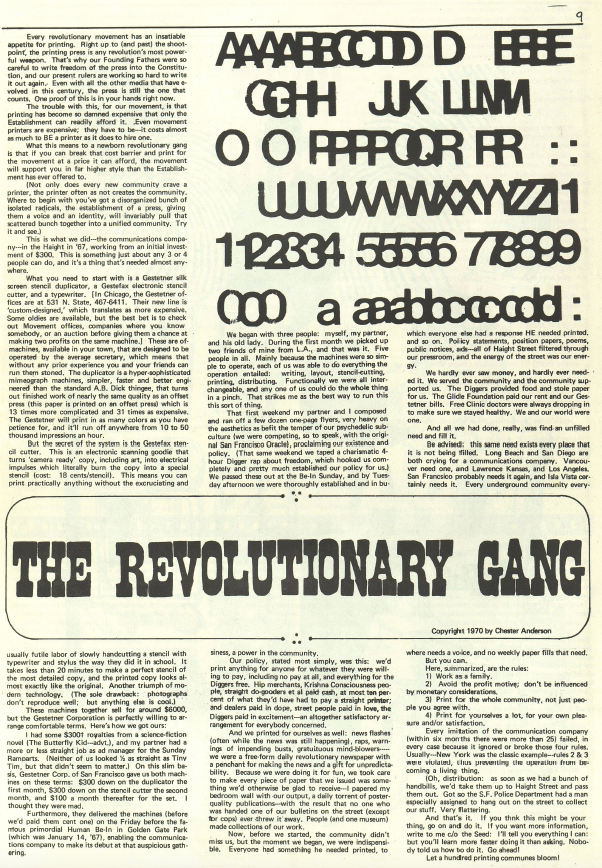
Or so I thought. Turns out Chester wrote two articles for counterculture newspaper The Seed in 1970. Called “The Revolutionary Gang,” these lovely, generous and typically Chester thinkpieces go into some detail about the workings of the Diggers, com/co, and the Haight. Chester ruminates on what worked during the period, and why. “The Revolution is the highest kind of fun,” he says, and “as a functioning social unit, the revolutionary gang has much to recommend it.” Here are some of Chester’s ideas on how to make the Revolution “in our new world borning.”

I’ve posted both articles below as PNGs. Click on each image for a larger PDF.

ChesterSeed1
ChesterSeed2

“The Do was the thing”: a lengthy chat with Chuck Gould of the San Francisco Diggers

Autosave-File vom d-lab2/3 der AgfaPhoto GmbH
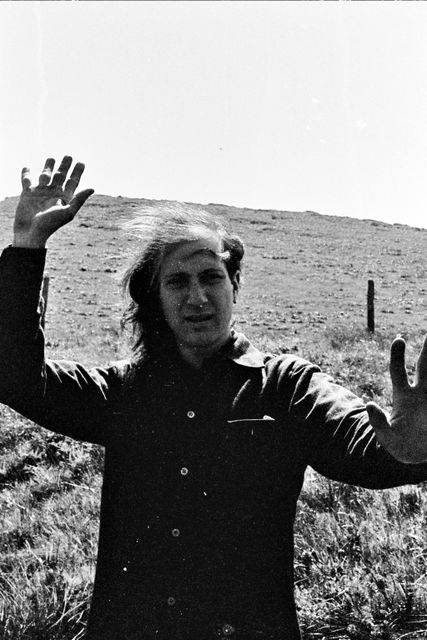
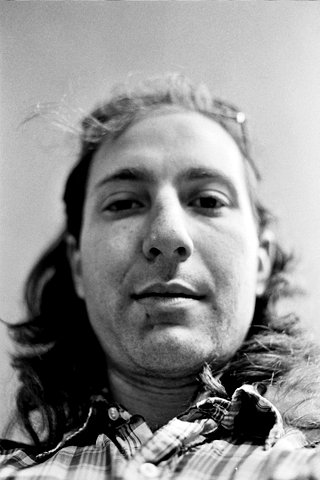
Chuck Gould

 The Diggers were meant to be loose, free and vaguely anonymous — or pseudonymous — but perhaps inevitably, some people’s names got out. Usually they were the ones who spoke to a reporter.

And there were a lot of reporters in the Haight-Ashbury during the Diggers’ heyday of 1966-8. Such was the Diggers’ presence and notoriety that seemingly every reporter filing a story on the Haight — even, memorably, a typically dyspeptic Joan Didion, for the Saturday Evening Post—included the Diggers in their account.

“A band of hippie do-gooders,” said Time magazine. “A true peace corps,” wrote local daily newspaper columnist (and future Rolling Stone editor) Ralph J. Gleason. “A cross between the Mad Bomber and Johnny Appleseed,” said future Yippie Paul Krassner in The Realist, “a combination of Lenny Bruce and Malcolm X, the illegitimate offspring resulting from the seduction of Mary Worth by an acidic anarchist.” Didion wrote, “In the official District mythology, [the Diggers] are supposed to be a group of anonymous good guys with no thought in their collective head but to lend a helping hand.”
Who were these guys? Actor Peter Coyote and the late Emmett Grogan are the usual names associated with the Diggers (and their later incarnation, sometimes called the Free Family collective), as they wrote books chronicling their participation in that era; Grogan’s Ringolevio (1972) is the most notorious. But there were many others who remained anonymous while participating in the various wildly audacious Digger initiatives of the time. (A vast archive about the Diggers is maintained by Eric Noble at diggers.org)

One of them is a man named Chuck Gould. Prior to interviewing Chuck in 2010 at his home in Petrolia, California, I didn’t know much about him, other than his name was the photographer credit for the bulk of the rather striking black-and-white photographs featured in Coyote’s memoir, Sleeping Where I Fall (1998). In conversation I found Chuck’s avuncular outspokenness, street lawyerly bluntness, and Buddhist bottom-lineness to be as striking, refreshing and vivid as his photographic portraiture. No mythologizing here; just facts, laughs and tough reckonings.

Continue reading ““The Do was the thing”: a lengthy chat with Chuck Gould of the San Francisco Diggers”