“I lucked out so many times, man”: CLAUDE HAYWARD on his life before, during and after his time with the San Francisco Diggers

ClaudeChesterLAFP
Partners in street print: Claude Hayward and Chester Anderson of the Haight’s Communications Company (com/co), from a March 31, 1967 Los Angeles Free Press profile (courtesy diggers.org)

What a joy it was to find Claude Hayward alive and well and ready to reminisce and think about the San Francisco Diggers back in 2011.

Claude was a shadowy figure in the Diggers — mentioned here and there by name in various accounts and memoirs, famously rendered as mysterious and evasive by Joan Didion (!), the one living guy who could talk in depth about the late Chester Anderson, his partner in printing over 600 broadsides (many of them Diggers-penned) as the Communication Company. Amongst Diggers and children of Diggers, wild stories abounded about Claude’s life before, during and since the Haight. I thought he might be hard to find. But he was right there all along, online, active on Daily Kos and easily reached by email.

I interviewed Claude in a San Francisco backyard on October 2, 2011. We were both in town for the public memorial to the recently departed Peter Berg. I think we were eating apples and drinking coffee. We got a lot of talking done; what follows is pretty much how the conversation went, with some edits for clarity, and some later additions and deletions from Claude.

In 2021, the Diggers are little-known. But in 1966-8, such was the Diggers’ presence and notoriety that seemingly every reporter filing a story on the Haight included the Diggers in their account. “A band of hippie do-gooders,” said Time magazine. “A true peace corps,” wrote local daily newspaper columnist (and future Rolling Stone editor) Ralph J. Gleason. The Beatles’ press officer Derek Taylor would write, “[The Diggers] were in my opinion the core of the whole underground counterculture because they were our conscience.”

This is the eighth interview in my series of Diggers’ oral histories; the others are accessible here. For more information on the Diggers, consult Eric Noble’s vast archive at diggers.org  

I have incurred not insignificant expenses in my Diggers research through the years. If you would like to support my work, please donate via PayPal. All donations, regardless of size, are greatly appreciated. Thank you!

— Jay Babcock (babcock.jay@gmail.com), October 2, 2021

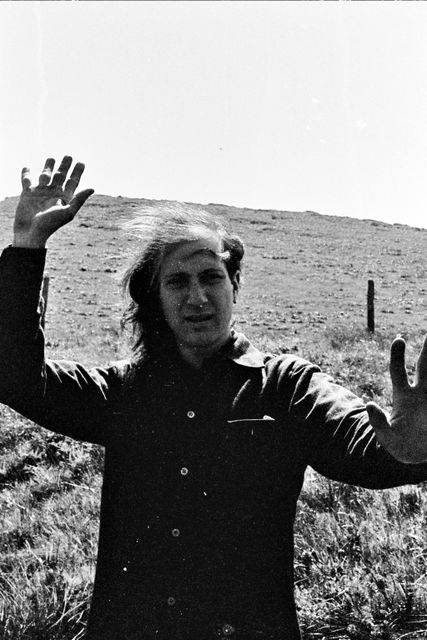
Claude Hayward, 2011.

Jay Babcock: What’s your background? Where did you grow up?

Claude Hayward: My mom’s dad had come over from Germany in 1930; he apparently got a job and made enough money in New York City to bring his family over five years later. Whether he was overtly political or he was just not going to tolerate this crap in Germany and managed to get himself out, I don’t know. He was working class, made stuff with his hands. My mother was born in Germany. She was 9 years old when she got here in 1935. She grew up on Long Island, met my dad at the Grumman Aircraft plant where she and her dad and my dad were all at work building airplanes just before the end of the war. I was born in Brooklyn in 1945.

I lived in Brooklyn in a couple places, then my mother re-married when I was 6 and we lived for part of a year in Greenwich Village, where my stepdad had an apartment. And then we moved out to New Jersey in 1952, some funky place in what’s now called Piscataway, outside of New Brunswick, and I grew up there, that was my boyhood. More country than not—pretty much free to run around, the woods, there were animals to be seen, there was a dairy farmer over the hill and all that. All kinds of Revolutionary War and pre-Revolutionary War ruins and stuff. Apparently Washington camped the Army right there. It was right across the street from Camp Kilmer.

What was your mother doing?

She was being a housewife. I have two half-brothers and a half-sister. They’re younger than I am. My mom took college classes as she could all through her family raising years, and eventually got a degree in English and a teaching credential in German, her native tongue. She was a mighty sharp cookie who somehow managed to impart some lasting values to me.

And your stepfather?

He was a broadcast studio engineer for WABD-TV Television in New York, which was actually the first commercial television station, created by Allen B. Dumont, the engineer who invented the method of mass-producing TV (cathode-ray) tubes that made the explosion of TV into American culture in the early ’50s possible. They were really pioneering stuff. They did Captain Video and Video Rangers live in the studio, 5 o’clock every afternoon. They did other stuff, just taking the camera out into the streets. Nobody had done that. They didn’t know what the fuck they were doing. They were trying to learn how to use this new medium.

So I was six years old and in a fifth-floor walk-up  apartment with a shared toilet in the hall. And I had my own television set! With tubes and a screen about that big. My stepdad was the kind of guy that could monkey around and fix it, he had boxes of tubes and resistors and capacitors and all that.

TV was the beginning of the great homogenization of American culture. That’s all you talked about in school: “Did you see Disneyland last night?” Which meant, did you have a television set? These were black-and-white TVs; color hadn’t gotten there for another couple of years.  I remember hearing schoolmates talking like what they had heard on TV the night before, imitating the mannerisms and idioms of speech.

We got out of there in ’59. My stepdad got a job to build the educational television station at Michigan State. I was there when they did the first live broadcast of a basketball game. Two semi trucks, with gigantic cables going out across the parking lot, the very first video tape recorders. Big Ampeg machines with two-inch tape. He was in at the beginning of all that. And he went on from there. He built the education television station for Santa Monica City College — KCRW — and he also worked in Las Vegas, put together the educational television station there at UNLV. He moved around and managed to get sideways with everybody and had to go find another job. I think the last job he was doing was working out at the Northridge campus in television, teaching people how to do the knobs and stuff.

He ran the radios for a group of tanks crossing France to liberate Europe and God knows what he saw. He never spoke of it. Came out of it bent, but managed to hold it all together long enough for his family to disintegrate around him as the ’60s crashed through. I, of course, had gotten away from that as soon as I could, by mid-’64.

All my family are builders. We learned that you could just do it. My stepdad got a Sears-Roebuck catalog and converted the coal furnace in the basement of the house to an oil-burning furnace by himself, soldering copper parts with a gasoline blowtorch. And what I learned from that was, Well yeah you just do it! There’s no sense of, I can’t do that, or, I’m not qualified. I think that’s got to be the most valuable lesson I ever had.

Continue reading ““I lucked out so many times, man”: CLAUDE HAYWARD on his life before, during and after his time with the San Francisco Diggers”
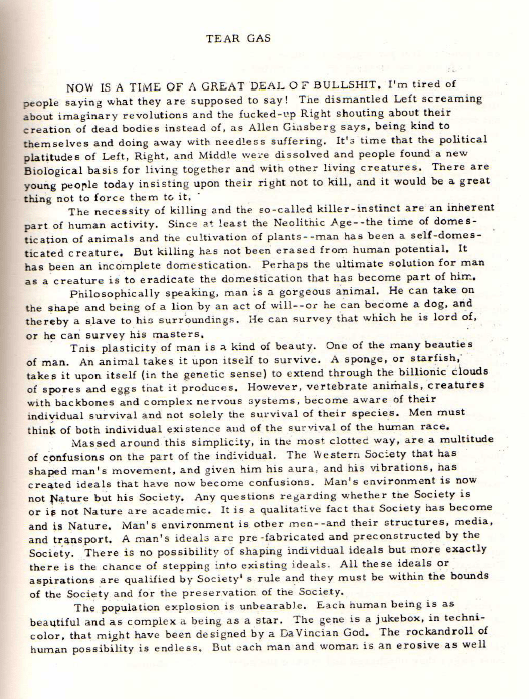
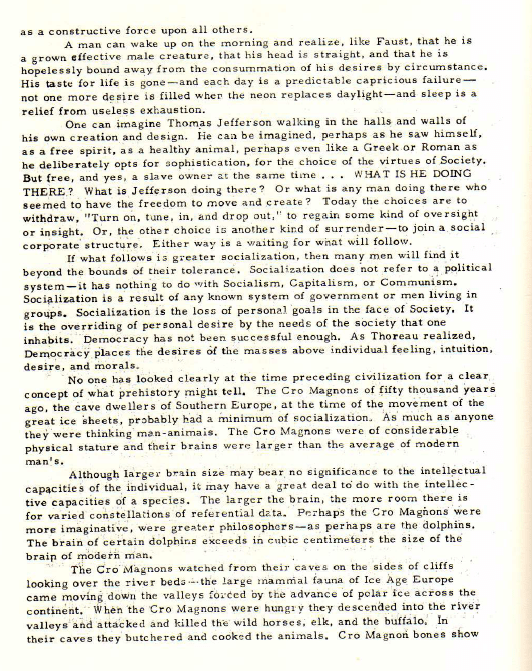
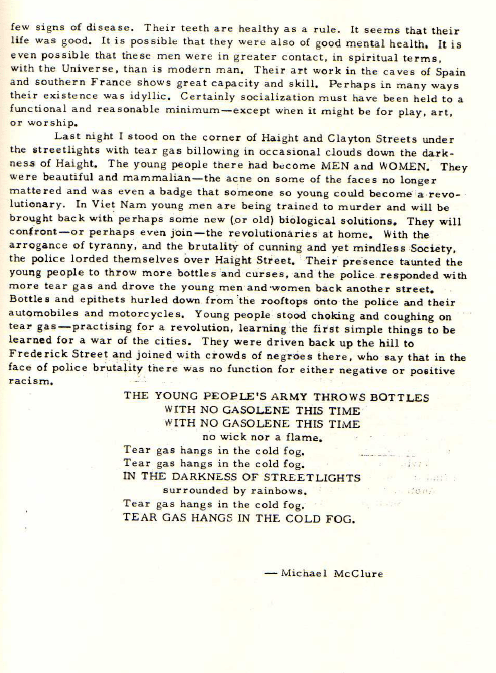
“TEAR GAS” by Michael McClure

From the introduction by Floating Bear editor Diane di Prima to the 1973 cloth edition collection of Floating Bear: A Newsletter published by Laurence McGilvery, as reprinted in the Beat Down to Your Soul anthology (ed. Ann Charters):

“‘Tear Gas’ by Michael McClure in Number 37 [March-July 1969] came my way in a kind of interesting way. There was an issue of The Realist, Paul Krassner’s magazine out of New York, that was devoted completely to the Diggers [No. 81/August 1968], and distributed free in San Francisco. And then there was a lot of leftover material that didn’t get into it, most of it unsigned. This leftover stuff was sent to my house in San Francisco by Emmett Grogan, so that Ron Thelin could get hold of it. Ron was one of the editors of the Oracle, but the Oracle had folded by then, and Ron wasn’t doing anything with the manuscript, so he left it with me. I found the piece by Michael, and stuck it in the last Bear…

“I edited Number 37 in San Francisco and deliberately aimed for a West Coast feeling. A whole bunch of the last issue, Number 37. was stamped ‘free’ and left at the Third Eye bookstore on Haight Street because I thought the people of the City of San Francisco should have it. I also left a handful at Cody’s and Moe’s in Berkeley. It was definitely a West Coast issue. The whole free city thing was going strong then, the Diggers and so on, and we wanted to have plenty of copies for everyone.”

Here is “Tear Gas” by Michael McClure, via the Floating Bear archive:

I TRULY BELIEVED: An in-depth conversation with Vicki Pollack of the San Francisco Diggers

screen-shot-2019-01-15-at-4.51.00-pm.png
Vicki Pollack, age 25, San Francisco, 1968.

Today Vicki Pollack is known as the legendary founder and director emeritus of the San Francisco Bay Area-based Children’s Book Project, the non-profit organization that has provided over 2.9 million “gently used” books to local kids since 1992. But in late 1967, Vicki was a directionless, 25-year-old college graduate and Civil Rights activist who’d left her welfare worker job in New York City to move to the Bay Area in pursuit of something more.

She found it in February, 1968, when she walked into an extraordinary old Victorian house on Willard Street in San Francisco. Some Diggers were living there, plotting to expand the audacious social liberation work they had spontaneously begun in the Haight-Ashbury district just 17 months prior. Now they were setting their sights on the whole of San Francisco.

Actor Peter Coyote and the late Emmett Grogan are the usual names associated with the Diggers, as they wrote books chronicling their participation in that era; Grogan’s Ringolevio is the most notorious. But there were many others, like Vicki, who participated in the various Digger initiatives of the time, and whose stories — and unique perspective and insights — have never been told at length, or in any detail, in public.

With that in mind, it gives me a great deal of pleasure to share this interview with Vicki, constructed from two conversations I had with her in San Francisco in 2010. There has been some editing for clarity, but for the most part, this has not been edited down for a general audience, and many incidents and personages are spoken of without context, or only in passing. As always, my advice to the casual-but-curious reader is to simply let these unfamiliar/unexplained bits pass. Keep reading, you’ll like the next part.

Continue reading “I TRULY BELIEVED: An in-depth conversation with Vicki Pollack of the San Francisco Diggers”

“The Do was the thing”: a lengthy chat with Chuck Gould of the San Francisco Diggers

Autosave-File vom d-lab2/3 der AgfaPhoto GmbH
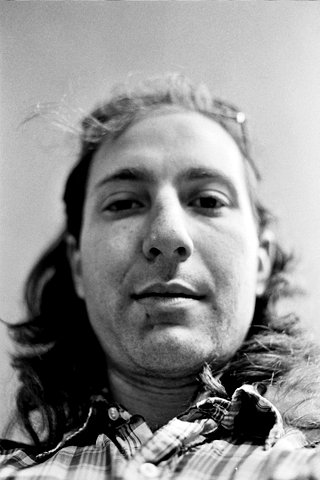
Chuck Gould

 The Diggers were meant to be loose, free and vaguely anonymous — or pseudonymous — but perhaps inevitably, some people’s names got out. Usually they were the ones who spoke to a reporter.

And there were a lot of reporters in the Haight-Ashbury during the Diggers’ heyday of 1966-8. Such was the Diggers’ presence and notoriety that seemingly every reporter filing a story on the Haight — even, memorably, a typically dyspeptic Joan Didion, for the Saturday Evening Post—included the Diggers in their account.

“A band of hippie do-gooders,” said Time magazine. “A true peace corps,” wrote local daily newspaper columnist (and future Rolling Stone editor) Ralph J. Gleason. “A cross between the Mad Bomber and Johnny Appleseed,” said future Yippie Paul Krassner in The Realist, “a combination of Lenny Bruce and Malcolm X, the illegitimate offspring resulting from the seduction of Mary Worth by an acidic anarchist.” Didion wrote, “In the official District mythology, [the Diggers] are supposed to be a group of anonymous good guys with no thought in their collective head but to lend a helping hand.”
Who were these guys? Actor Peter Coyote and the late Emmett Grogan are the usual names associated with the Diggers (and their later incarnation, sometimes called the Free Family collective), as they wrote books chronicling their participation in that era; Grogan’s Ringolevio (1972) is the most notorious. But there were many others who remained anonymous while participating in the various wildly audacious Digger initiatives of the time. (A vast archive about the Diggers is maintained by Eric Noble at diggers.org)

One of them is a man named Chuck Gould. Prior to interviewing Chuck in 2010 at his home in Petrolia, California, I didn’t know much about him, other than his name was the photographer credit for the bulk of the rather striking black-and-white photographs featured in Coyote’s memoir, Sleeping Where I Fall (1998). In conversation I found Chuck’s avuncular outspokenness, street lawyerly bluntness, and Buddhist bottom-lineness to be as striking, refreshing and vivid as his photographic portraiture. No mythologizing here; just facts, laughs and tough reckonings.

Continue reading ““The Do was the thing”: a lengthy chat with Chuck Gould of the San Francisco Diggers”

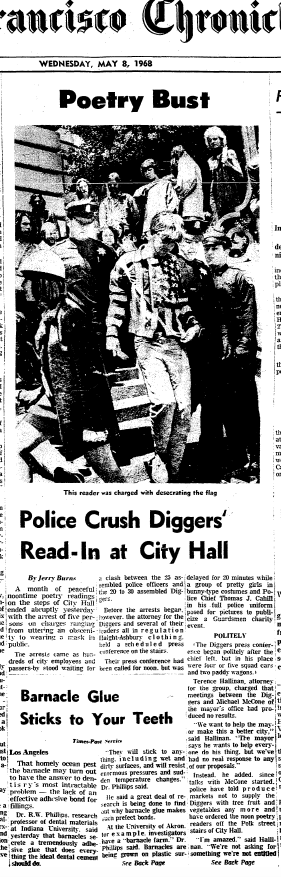
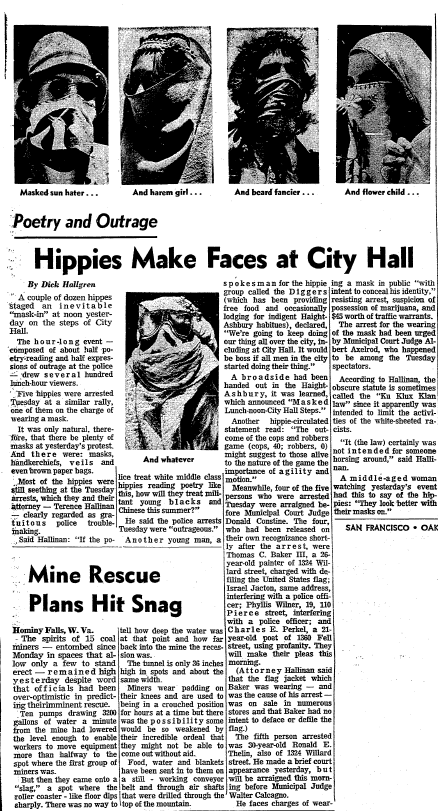
“Poetry Bust: Police Crush Diggers’ Read-In at City Hall”/”Poetry and Outrage: Hippies Make Faces at City Hall” (May 1968)

screen shot 2019-01-14 at 12.46.04 pm

poetrybustcontinued

San Francisco Chronicle: May 8, 1968

Police Crush Diggers’ Read-In at City Hall

by Jerry Burns

A month of peaceful noontime poetry readings on the steps of City Hall ended abruptly yesterday with the arrest of five persons on charges ranging from uttering an obscenity to wearing a mask in public.

The arrests came as hundreds of city employees and passers-by stood waiting for a clash between the 25 assembled police officers and the 20 to 30 assembled Diggers.

Before the arrests began, however, the attorney for the Diggers and several of their leaders all in regulation Haight-Ashbury clothing held a scheduled press conference on the stairs.

Their press conference had been called for noon, but was delayed for 20 minutes while a group of pretty girls in bunny-type costumes and Police Chief Thomas J. Cahill in his full police uniform posed for pictures to publicize a Guardsmen charity event.

POLITELY

The Diggers press conference began politely after the chief left, but in his place where four or five squad cars and two paddy wagons.

Terence Hallinan, attorney for the group, charged that meetings between the Diggers and Michael McCone of the mayor’s office had produced no results.

“We want to help the mayor make this a better city,” said Hallinan. “The mayor says he wants to help everyone do his thing, but we’ve had no real response to any of our proposals.”

Instead, he added, since talks with McCone started, police have told produce markets not to supply the Diggers with free fruit and vegetable anymore and have ordered the noon poetry readers off the Polk Street stairs of City Hall.

“I’m amazed,” said Hallinan. “We’re not asking for something we’re not entitled to. My clients are talented people who offer to do things for the city for free.”

The five-point program offered by the Diggers asks that they be allowed to restore empty city-owned buildings, in redevelopment areas, for people to live rent-free, that surplus food be distributed through ten neighborhood free stores, that presses and trucks be made available for dissemination of “free news,” that neighborhoods be provided with resources for celebrations of “the city, the planet and their own free beings,” and that permits no longer be needed for using parks and other public spaces.

The apparent leader of the Diggers — a young man identifying himself as Peter or “William Bonney” — said that San Francisco can “burn, or turn into a model for the rest of the cities to follow, with radical alternatives to riots and all those corny numbers.”

POEM

With the press conference over, another member of the Diggers climbed atop the granite side of the stairs and began to read a poem on America.

He was wearing a shirt either made out of an American flag or from a print resembling a flag.

In either event, police moved in and took him off the stairs. He was put under arrest for Section 614D of the Military and Veterans Code, which makes it a crime to “publicly mutilate, deface, defile or trample” the flag.

Also arrested, a moment later, was another young man who shouted a four-letter word — meaning, to make love. He was charged with profanity.

WATCHING

Police and the remaining Diggers then stood around, watching each other. Hundreds of others, many on late lunch hours or early coffee breaks, watched the watchers.

Then Municipal Court Judge Albert Axelrod wandered up to a Digger wearing a colorful red bandana as a mask and asked him why.

“I have a right to conceal my identity,” the young man replied. (Earlier he told reporters: “I wear a mask so I can intellectualize my fantasy, which is to be free.”)

Axelrod told the man he didn’t have that right and cited Section 650a of the Penal Code, which says it is a crime for any person “to appear on any street or highway or in other public places…with his face partially or completely concealed by means of a mask or other regalia or paraphernalia, with intent to conceal his identity.”

EXCEPTIONS

(The law exempts persons wearing masks “in good faith for the purposes of amusement, entertainment or in compliance with any public health order.”)

The young man attempted to walk away from Judge Axelrod, but was grabbed by police. He struggled briefly and was wrestled into a second paddy wagon.

Another Digger, with close-cropped hair on the top of his head, a pig-tail and a robe-like garment, grabbed his masked friend around the legs and he, too, was put in the police van.

The final person arrested was a young lady. It was not immediately certain what the charge against her was.

CROWD

After the fifth arrest, police continued to stand around for 15 or 20 minutes. Then they left and the crowd broke up and went back to their desks.

Many of the same young men and women have been entertaining — and often infuriating — lunch crowds on the City Hall steps with their poems and music.

They have also handed out free food. Yesterday, it was apples, but on other days it has included oranges and even strawberries.

Until Monday, police had not bothered them. Most of the listeners had appeared to enjoy the poems of anti-middle-class outrage and the young Digger girls with an aversion to underclothing.

By coincidence, Monday’s first roust came at a time the mayor was out of the city.

Screen Shot 2019-02-19 at 12.43.24 PM
May 9, 1968 San Francisco Chronicle


“For the Duration of Our Parallel Flow”: An epic interview with Phyllis Willner of the San Francisco Diggers

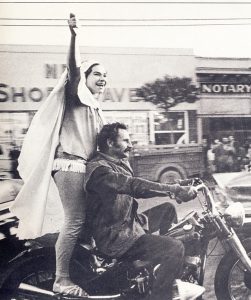
ganthonyphyllis
1966 in the Haight-Ashbury in a single image: caped teenage runaway Phyllis Willner rides with Hell’s Angel Hairy Henry Kot, yelling “Free!” to “Now! Day” celebrants and onlookers. Photo by Gene Anthony.
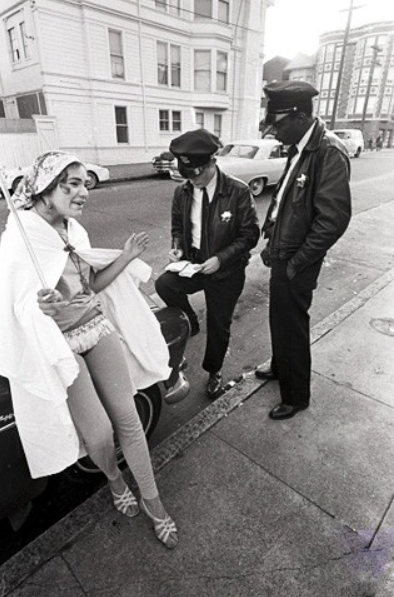
Explainer
Later that day: Phyllis Willner (left) explains herself. Photo by Gene Anthony.

In October 1966, Phyllis Willner arrived on motorcycle in San Francisco as a teenage Jewish runaway from Jamaica, Queens. She quickly fell in with the Hell’s Angels, the San Francisco Mime Troupe and, most crucially, the Diggers, who were just getting their street radical thing together in the Haight-Ashbury.

The next two years would be eventful: many extraordinary highs, some really terrible lows.

Anyone familiar with the ’60s Counter-culture knows the key role* the Diggers played in its birth and adolescence; the general outline of their influential group praxis; and may even be able to recall a name or three associated with them: actor Peter Coyote and the late Emmett Grogan are the usual ones that come up, as they’ve written books chronicling their participation in that era; Grogan’s Ringolevio is the most notorious. Although Phyllis Willner’s name and image exist in contemporaneous news accounts and later histories of the era (see especially The Summer of Love, by Gene Anthony), she is one of many essential Diggers whose story — and unique, fascinating perspective and insights — has never been told at length, or in any detail, in public.

With that in mind, it gives me a great deal of pleasure to share this conversation I had with Phyllis at her home in Arcata, California in 2010. There has been some editing for clarity, but for the most part this is how the conversation went over three hours; it has not been edited down for a general audience, and many incidents and personages are spoken of without context, or only in passing. My advice to the casual-but-curious reader is to simply let these unfamiliar/unexplained bits pass. Keep reading, you’ll like the next part.

Continue reading ““For the Duration of Our Parallel Flow”: An epic interview with Phyllis Willner of the San Francisco Diggers”