
San Francisco Chronicle: May 8, 1968
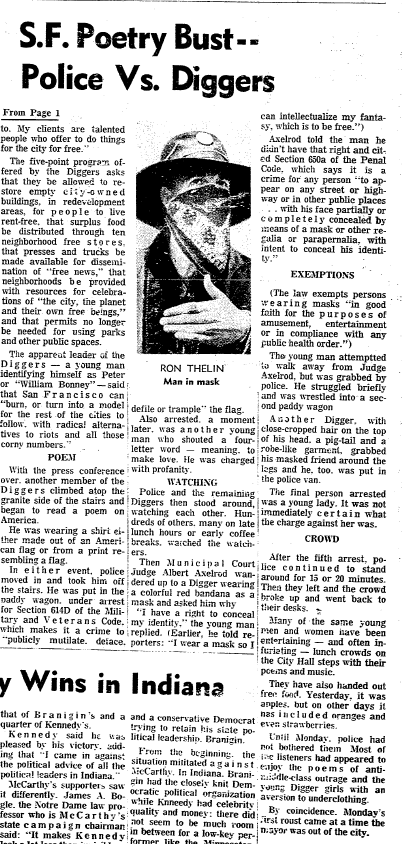
Police Crush Diggers’ Read-In at City Hall
by Jerry Burns
A month of peaceful noontime poetry readings on the steps of City Hall ended abruptly yesterday with the arrest of five persons on charges ranging from uttering an obscenity to wearing a mask in public.
The arrests came as hundreds of city employees and passers-by stood waiting for a clash between the 25 assembled police officers and the 20 to 30 assembled Diggers.
Before the arrests began, however, the attorney for the Diggers and several of their leaders all in regulation Haight-Ashbury clothing held a scheduled press conference on the stairs.
Their press conference had been called for noon, but was delayed for 20 minutes while a group of pretty girls in bunny-type costumes and Police Chief Thomas J. Cahill in his full police uniform posed for pictures to publicize a Guardsmen charity event.
POLITELY
The Diggers press conference began politely after the chief left, but in his place where four or five squad cars and two paddy wagons.
Terence Hallinan, attorney for the group, charged that meetings between the Diggers and Michael McCone of the mayor’s office had produced no results.
“We want to help the mayor make this a better city,” said Hallinan. “The mayor says he wants to help everyone do his thing, but we’ve had no real response to any of our proposals.”
Instead, he added, since talks with McCone started, police have told produce markets not to supply the Diggers with free fruit and vegetable anymore and have ordered the noon poetry readers off the Polk Street stairs of City Hall.
“I’m amazed,” said Hallinan. “We’re not asking for something we’re not entitled to. My clients are talented people who offer to do things for the city for free.”
The five-point program offered by the Diggers asks that they be allowed to restore empty city-owned buildings, in redevelopment areas, for people to live rent-free, that surplus food be distributed through ten neighborhood free stores, that presses and trucks be made available for dissemination of “free news,” that neighborhoods be provided with resources for celebrations of “the city, the planet and their own free beings,” and that permits no longer be needed for using parks and other public spaces.
The apparent leader of the Diggers — a young man identifying himself as Peter or “William Bonney” — said that San Francisco can “burn, or turn into a model for the rest of the cities to follow, with radical alternatives to riots and all those corny numbers.”
POEM
With the press conference over, another member of the Diggers climbed atop the granite side of the stairs and began to read a poem on America.
He was wearing a shirt either made out of an American flag or from a print resembling a flag.
In either event, police moved in and took him off the stairs. He was put under arrest for Section 614D of the Military and Veterans Code, which makes it a crime to “publicly mutilate, deface, defile or trample” the flag.
Also arrested, a moment later, was another young man who shouted a four-letter word — meaning, to make love. He was charged with profanity.
WATCHING
Police and the remaining Diggers then stood around, watching each other. Hundreds of others, many on late lunch hours or early coffee breaks, watched the watchers.
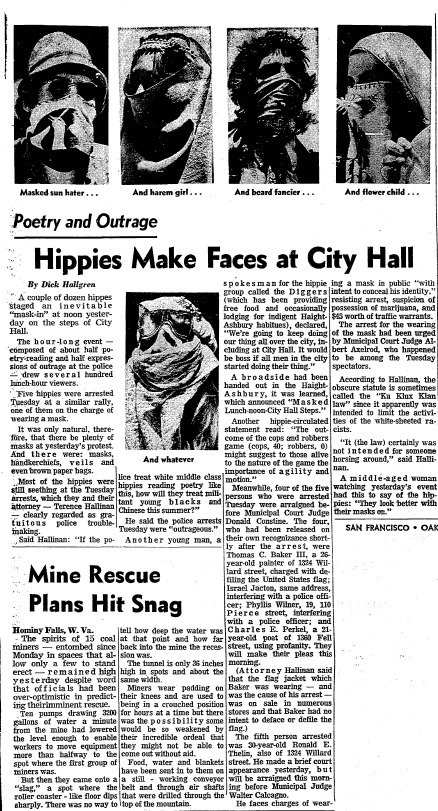
Then Municipal Court Judge Albert Axelrod wandered up to a Digger wearing a colorful red bandana as a mask and asked him why.
“I have a right to conceal my identity,” the young man replied. (Earlier he told reporters: “I wear a mask so I can intellectualize my fantasy, which is to be free.”)
Axelrod told the man he didn’t have that right and cited Section 650a of the Penal Code, which says it is a crime for any person “to appear on any street or highway or in other public places…with his face partially or completely concealed by means of a mask or other regalia or paraphernalia, with intent to conceal his identity.”
EXCEPTIONS
(The law exempts persons wearing masks “in good faith for the purposes of amusement, entertainment or in compliance with any public health order.”)
The young man attempted to walk away from Judge Axelrod, but was grabbed by police. He struggled briefly and was wrestled into a second paddy wagon.
Another Digger, with close-cropped hair on the top of his head, a pig-tail and a robe-like garment, grabbed his masked friend around the legs and he, too, was put in the police van.
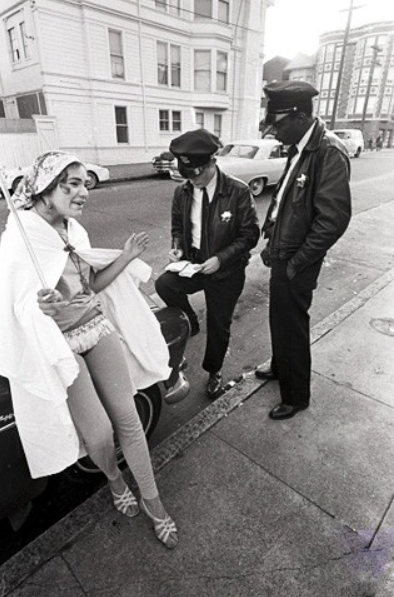
The final person arrested was a young lady. It was not immediately certain what the charge against her was.
CROWD
After the fifth arrest, police continued to stand around for 15 or 20 minutes. Then they left and the crowd broke up and went back to their desks.
Many of the same young men and women have been entertaining — and often infuriating — lunch crowds on the City Hall steps with their poems and music.
They have also handed out free food. Yesterday, it was apples, but on other days it has included oranges and even strawberries.
Until Monday, police had not bothered them. Most of the listeners had appeared to enjoy the poems of anti-middle-class outrage and the young Digger girls with an aversion to underclothing.
By coincidence, Monday’s first roust came at a time the mayor was out of the city.


 Diggers Docs