“We had a far more profound effect on society than we really understood, and some of us paid for that”: An epic conversation with JANE LAPINER and DAVID SIMPSON of the San Francisco Diggers

In 2010, I drove to northern California from my home in Joshua Tree to interview as many living Diggers as would talk to me. Each conversation over those few days felt like a breakthrough—a motherlode of historical detail and insight beyond what I had gleaned from book research. And each Digger I interviewed was excited to learn that I was headed to Humboldt County to interview Jane Lapiner and David Simpson at their forest home. This couple, together since April, 1967, was beloved by other Diggers. If I was interviewing them, it meant that I was really doing my work. Instant Diggers cred.

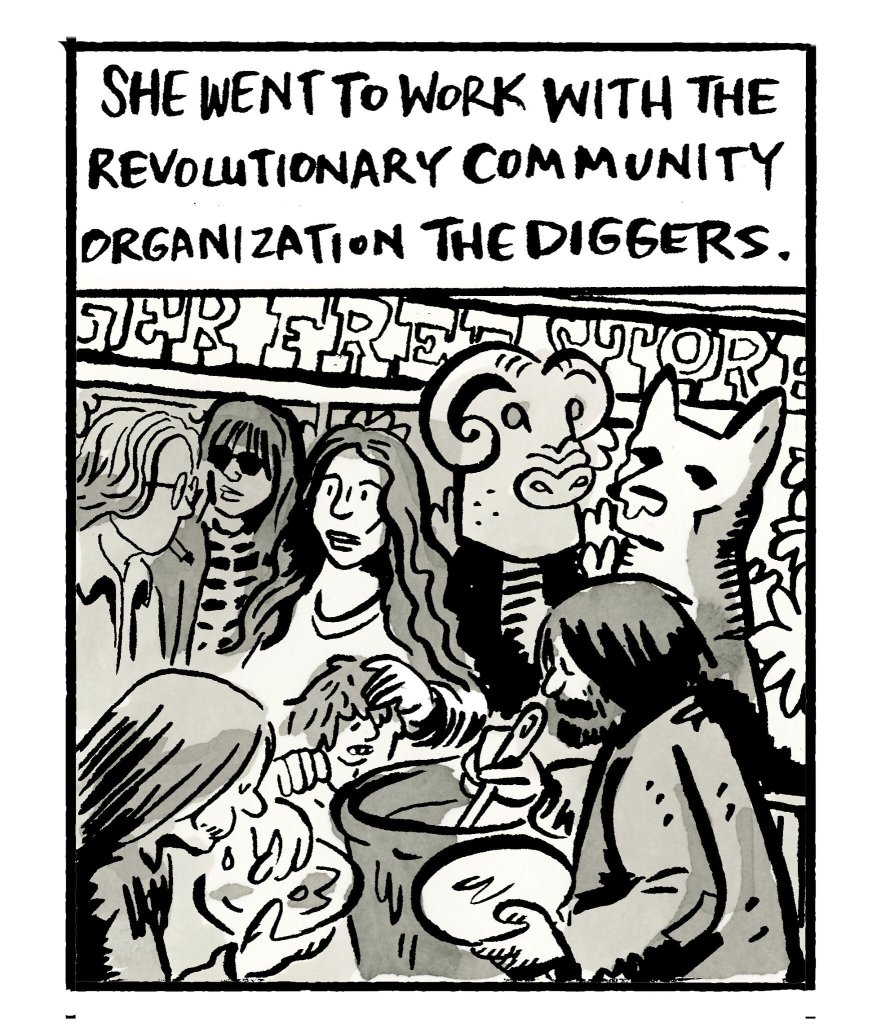
In 2022, the Diggers are little-known. But in 1966-8, such was the Diggers’ presence and notoriety that seemingly every reporter filing a story on the Haight included the Diggers in their account. “A band of hippie do-gooders,” said Time magazine. “A true peace corps,” wrote local daily newspaper columnist (and future Rolling Stone editor) Ralph J. Gleason. The Beatles’ press officer Derek Taylor would later write, “[The Diggers] were in my opinion the core of the whole underground counterculture because they were our conscience.”

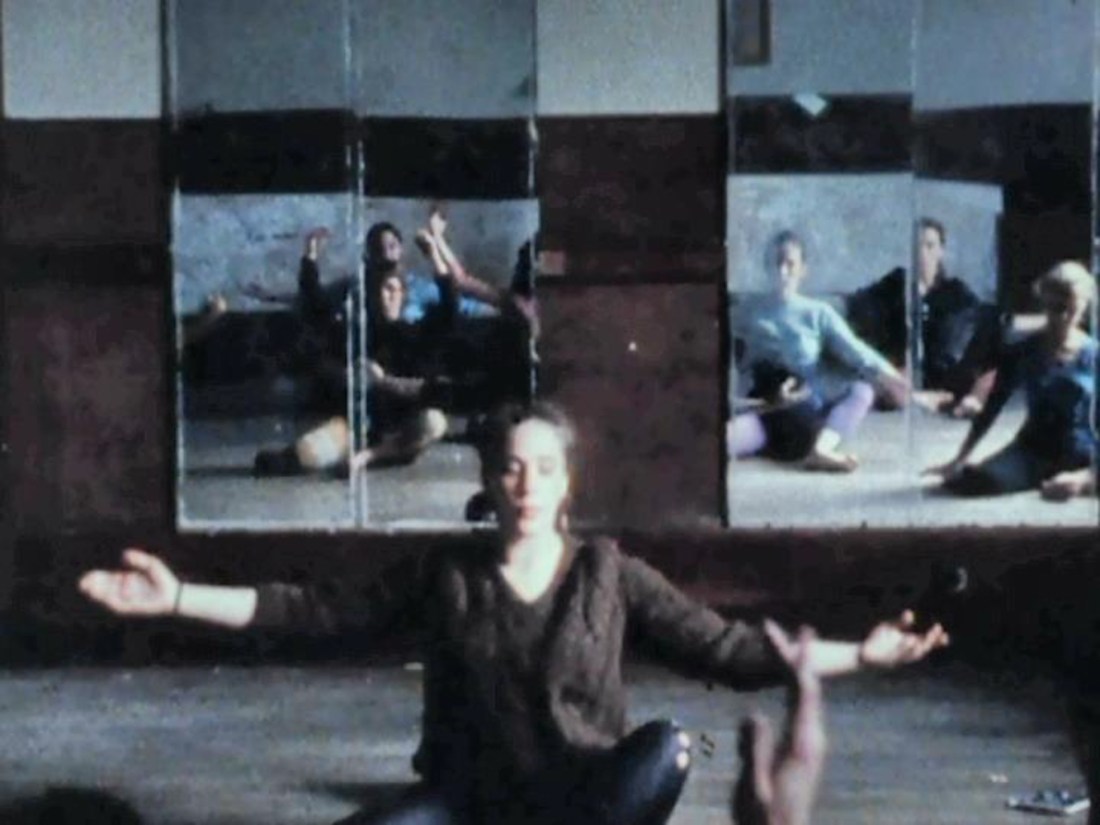
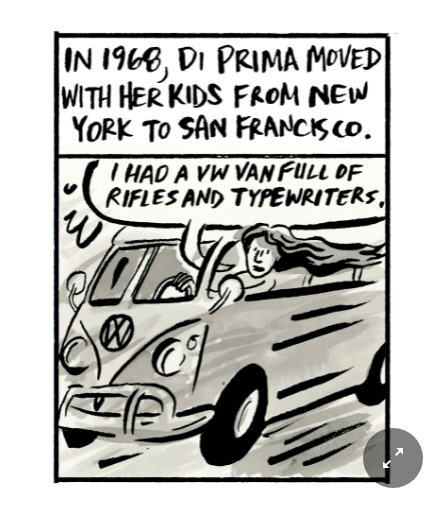
Jane Lapiner and David Simpson were in their mid-20s during the Diggers period. Jane was a single mother from New York City with a background in leftist, avant garde dance; David was a Chicago-bred lefty dropout from the University of Wisconsin, who’d been a competitive boxer in high school, shared a house with pre-stardom Steve Miller and Boz Scaggs, served in the Coast Guard and was trimming trees in the East Bay when… But hold on, I’m telling their stories, instead of letting these award-winning storytellers tell it themselves. 

What follows is a consolidation of conversations the three of us had one night and the next morning inside their farmhouse home, warmed by a wood stove and good food. I am grateful for their hospitality, and the life-example they continue to set (for example, see: “Judge Dismisses Case Against Four Septuagenarian Rainbow Ridge Activists, North Coast Journal, Dec. 15, 2020). There are some ‘60s people who went back to the land and didn’t fail. Jane and David are those people. 

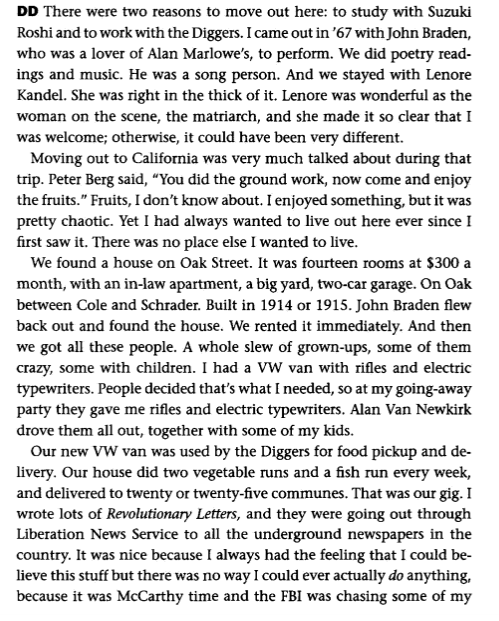
David Simpson and Jane Lapiner at home, 2010. Photo by Bob Doran for North County Journal

Please note that this conversation has not been edited down for a general audience. Many incidents and personages are spoken of without context, or only in passing. My advice to the casual-but-curious reader is to simply let any unfamiliar/unexplained bits pass. Keep reading, you’ll like the next part. You’ll see why these two are so beloved.

This is the ninth interview in my series of Diggers’ oral histories; the others are accessible here. For more information on the Diggers, consult Eric Noble’s vast archive at diggers.org  

I have incurred not insignificant expenses in my Diggers research through the years. If you would like to support my work, you can help out by buying me a cup of coffee or dropping some coins in my paypal TipJar. All donations, regardless of size, are greatly appreciated. Thank you!

— Jay Babcock (babcock.jay@gmail.com), March 5, 2022

Continue reading ““We had a far more profound effect on society than we really understood, and some of us paid for that”: An epic conversation with JANE LAPINER and DAVID SIMPSON of the San Francisco Diggers”
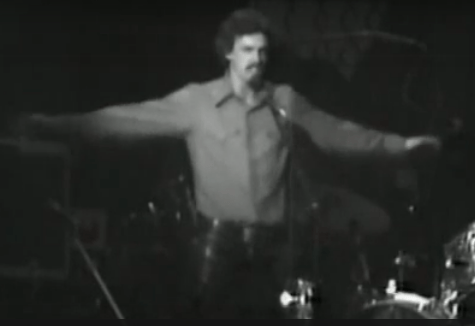
“Come dance with me across my sparkling nerves”: Lenore Kandel and other Digger poets at the Band’s ‘Last Waltz’ (San Francisco, 1976)

Readings by:

Emmett Grogan:

Sweet William (Bill Fritsch):

Lenore Kandel:

Diane di Prima:

Freewheelin Frank Reynolds:

(Note: poets Michael McClure, Robert Duncan and Lawrence Ferlinghetti also read)


The Band’s Perfect Goodbye

A Behind-the-Scenes Report by Emmett Grogan

(originally published in Oui Magazine)


On December 6, 1969, I attended a concert at a race track in Livermore, near Altamont, California. Three hundred thousand people gathered on the grounds to see and hear rock performers on a crowded stage. Several cameramen were positioned at various angles to record the event as part of a documentary on The Rolling Stones’ concert tour of America. One of the cameramen got lucky. His lens was focused on the right place at the right time. The scene he recorded — the murder of an audience member by Hell’s Angels “security men” — became the dramatic highlight of the documentary Gimme Shelter. Like the photographing of this scene, the Altamont concert itself had happened by accident. And most of it went wrong. Nothing was planned. Everything was winged, improvised on the spot. Like life. Like death.

Six years passed before I went to another concert in the San Francisco Bay area, and this was an orchestrated event in which nothing was left to be played by ear, not even the music. The Band’s Last Waltz was as calculated as a pension. Every aspect of the production was carefully charted, as were the planets governing the stars. Nothing was overlooked or given space to simply happen. The planning was meticulous, the affair thoroughly cased, like a Willie Sutton bank job.

The Last Waltz was not only a hit, it was a major-league home run with the bases loaded. A grand slam. The Los Angeles Times called it “the most prestigious collection of rock stars ever assembled for a single show.” An elegant rambling moved Eric Clapton to remark, “Don’t think there will be anything like it ever again. Ever.” He’s right. There won’t be another gathering quite like it. In the year of Nadia Comăneci, the timing was perfect. According to a professional astrologist, the day was excessively rare. The sort of day you wait for years to happen. The kind of day that won’t happen for perhaps another decade.

Continue reading ““Come dance with me across my sparkling nerves”: Lenore Kandel and other Digger poets at the Band’s ‘Last Waltz’ (San Francisco, 1976)”

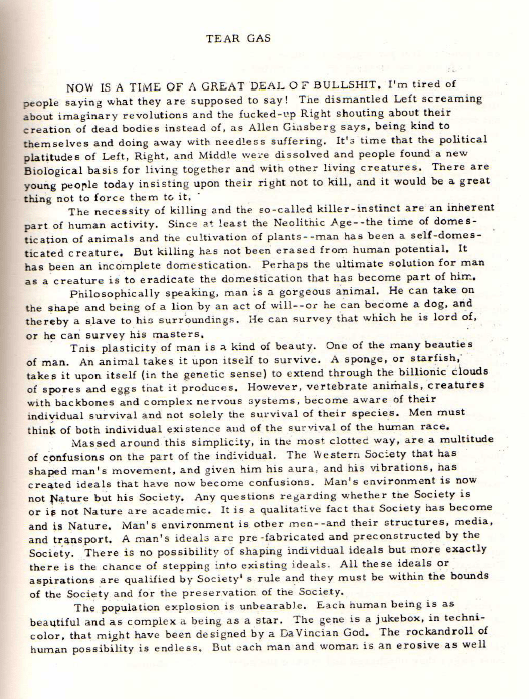
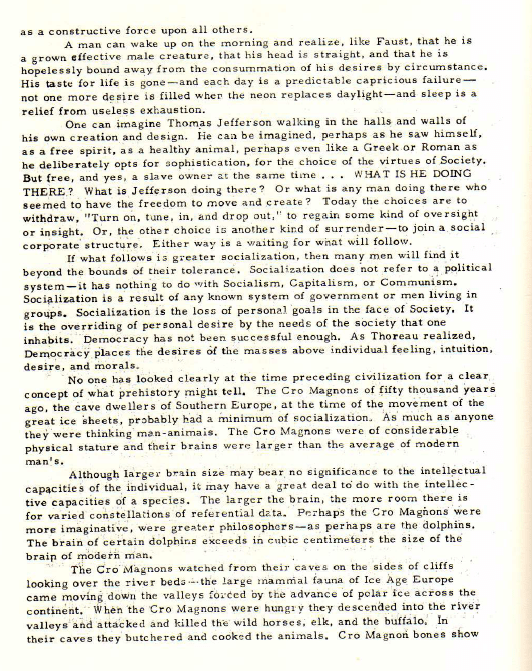
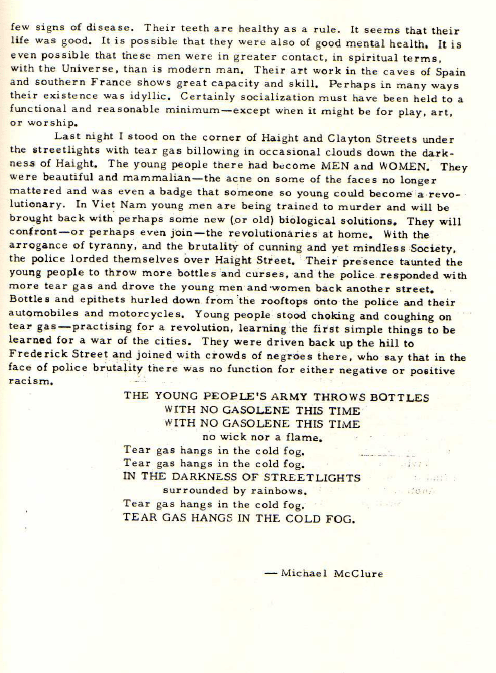
“TEAR GAS” by Michael McClure

From the introduction by Floating Bear editor Diane di Prima to the 1973 cloth edition collection of Floating Bear: A Newsletter published by Laurence McGilvery, as reprinted in the Beat Down to Your Soul anthology (ed. Ann Charters):

“‘Tear Gas’ by Michael McClure in Number 37 [March-July 1969] came my way in a kind of interesting way. There was an issue of The Realist, Paul Krassner’s magazine out of New York, that was devoted completely to the Diggers [No. 81/August 1968], and distributed free in San Francisco. And then there was a lot of leftover material that didn’t get into it, most of it unsigned. This leftover stuff was sent to my house in San Francisco by Emmett Grogan, so that Ron Thelin could get hold of it. Ron was one of the editors of the Oracle, but the Oracle had folded by then, and Ron wasn’t doing anything with the manuscript, so he left it with me. I found the piece by Michael, and stuck it in the last Bear…

“I edited Number 37 in San Francisco and deliberately aimed for a West Coast feeling. A whole bunch of the last issue, Number 37. was stamped ‘free’ and left at the Third Eye bookstore on Haight Street because I thought the people of the City of San Francisco should have it. I also left a handful at Cody’s and Moe’s in Berkeley. It was definitely a West Coast issue. The whole free city thing was going strong then, the Diggers and so on, and we wanted to have plenty of copies for everyone.”

Here is “Tear Gas” by Michael McClure, via the Floating Bear archive:

I TRULY BELIEVED: An in-depth conversation with Vicki Pollack of the San Francisco Diggers

screen-shot-2019-01-15-at-4.51.00-pm.png
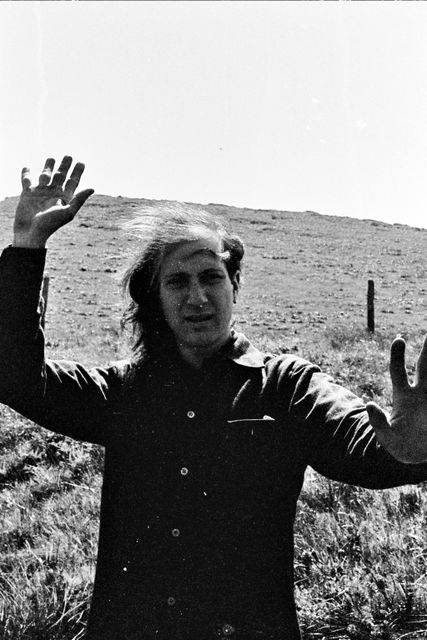
Vicki Pollack, age 25, San Francisco, 1968.

Today Vicki Pollack is known as the legendary founder and director emeritus of the San Francisco Bay Area-based Children’s Book Project, the non-profit organization that has provided over 2.9 million “gently used” books to local kids since 1992. But in late 1967, Vicki was a directionless, 25-year-old college graduate and Civil Rights activist who’d left her welfare worker job in New York City to move to the Bay Area in pursuit of something more.

She found it in February, 1968, when she walked into an extraordinary old Victorian house on Willard Street in San Francisco. Some Diggers were living there, plotting to expand the audacious social liberation work they had spontaneously begun in the Haight-Ashbury district just 17 months prior. Now they were setting their sights on the whole of San Francisco.

Actor Peter Coyote and the late Emmett Grogan are the usual names associated with the Diggers, as they wrote books chronicling their participation in that era; Grogan’s Ringolevio is the most notorious. But there were many others, like Vicki, who participated in the various Digger initiatives of the time, and whose stories — and unique perspective and insights — have never been told at length, or in any detail, in public.

With that in mind, it gives me a great deal of pleasure to share this interview with Vicki, constructed from two conversations I had with her in San Francisco in 2010. There has been some editing for clarity, but for the most part, this has not been edited down for a general audience, and many incidents and personages are spoken of without context, or only in passing. As always, my advice to the casual-but-curious reader is to simply let these unfamiliar/unexplained bits pass. Keep reading, you’ll like the next part.

Continue reading “I TRULY BELIEVED: An in-depth conversation with Vicki Pollack of the San Francisco Diggers”
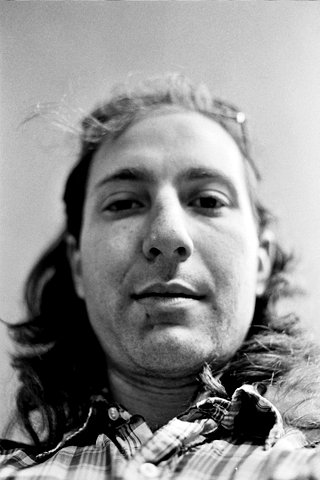
“The Do was the thing”: a lengthy chat with Chuck Gould of the San Francisco Diggers

Autosave-File vom d-lab2/3 der AgfaPhoto GmbH
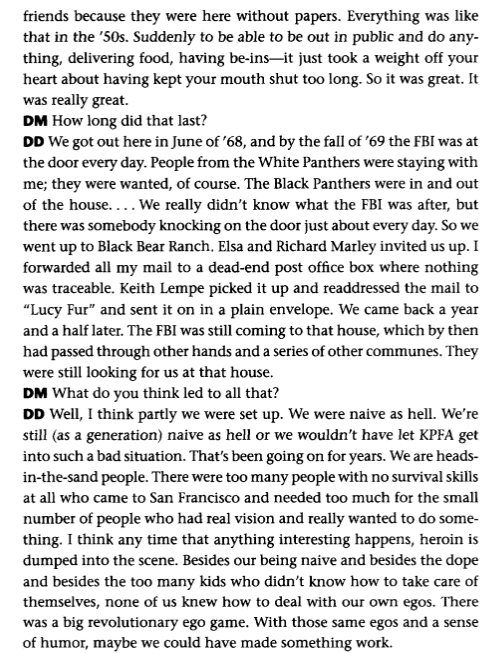
Chuck Gould

 The Diggers were meant to be loose, free and vaguely anonymous — or pseudonymous — but perhaps inevitably, some people’s names got out. Usually they were the ones who spoke to a reporter.

And there were a lot of reporters in the Haight-Ashbury during the Diggers’ heyday of 1966-8. Such was the Diggers’ presence and notoriety that seemingly every reporter filing a story on the Haight — even, memorably, a typically dyspeptic Joan Didion, for the Saturday Evening Post—included the Diggers in their account.

“A band of hippie do-gooders,” said Time magazine. “A true peace corps,” wrote local daily newspaper columnist (and future Rolling Stone editor) Ralph J. Gleason. “A cross between the Mad Bomber and Johnny Appleseed,” said future Yippie Paul Krassner in The Realist, “a combination of Lenny Bruce and Malcolm X, the illegitimate offspring resulting from the seduction of Mary Worth by an acidic anarchist.” Didion wrote, “In the official District mythology, [the Diggers] are supposed to be a group of anonymous good guys with no thought in their collective head but to lend a helping hand.”
Who were these guys? Actor Peter Coyote and the late Emmett Grogan are the usual names associated with the Diggers (and their later incarnation, sometimes called the Free Family collective), as they wrote books chronicling their participation in that era; Grogan’s Ringolevio (1972) is the most notorious. But there were many others who remained anonymous while participating in the various wildly audacious Digger initiatives of the time. (A vast archive about the Diggers is maintained by Eric Noble at diggers.org)

One of them is a man named Chuck Gould. Prior to interviewing Chuck in 2010 at his home in Petrolia, California, I didn’t know much about him, other than his name was the photographer credit for the bulk of the rather striking black-and-white photographs featured in Coyote’s memoir, Sleeping Where I Fall (1998). In conversation I found Chuck’s avuncular outspokenness, street lawyerly bluntness, and Buddhist bottom-lineness to be as striking, refreshing and vivid as his photographic portraiture. No mythologizing here; just facts, laughs and tough reckonings.

Continue reading ““The Do was the thing”: a lengthy chat with Chuck Gould of the San Francisco Diggers”

“For the Duration of Our Parallel Flow”: An epic interview with Phyllis Willner of the San Francisco Diggers

ganthonyphyllis
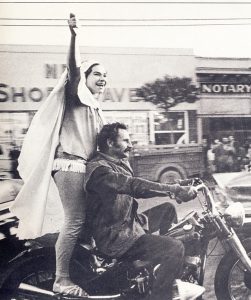
1966 in the Haight-Ashbury in a single image: caped teenage runaway Phyllis Willner rides with Hell’s Angel Hairy Henry Kot, yelling “Free!” to “Now! Day” celebrants and onlookers. Photo by Gene Anthony.
Explainer
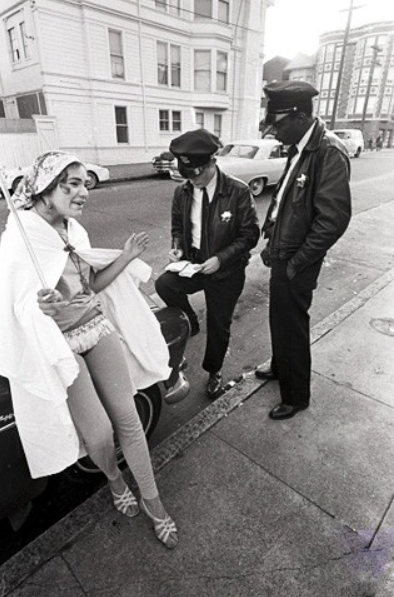
Later that day: Phyllis Willner (left) explains herself. Photo by Gene Anthony.

In October 1966, Phyllis Willner arrived on motorcycle in San Francisco as a teenage Jewish runaway from Jamaica, Queens. She quickly fell in with the Hell’s Angels, the San Francisco Mime Troupe and, most crucially, the Diggers, who were just getting their street radical thing together in the Haight-Ashbury.

The next two years would be eventful: many extraordinary highs, some really terrible lows.

Anyone familiar with the ’60s Counter-culture knows the key role* the Diggers played in its birth and adolescence; the general outline of their influential group praxis; and may even be able to recall a name or three associated with them: actor Peter Coyote and the late Emmett Grogan are the usual ones that come up, as they’ve written books chronicling their participation in that era; Grogan’s Ringolevio is the most notorious. Although Phyllis Willner’s name and image exist in contemporaneous news accounts and later histories of the era (see especially The Summer of Love, by Gene Anthony), she is one of many essential Diggers whose story — and unique, fascinating perspective and insights — has never been told at length, or in any detail, in public.

With that in mind, it gives me a great deal of pleasure to share this conversation I had with Phyllis at her home in Arcata, California in 2010. There has been some editing for clarity, but for the most part this is how the conversation went over three hours; it has not been edited down for a general audience, and many incidents and personages are spoken of without context, or only in passing. My advice to the casual-but-curious reader is to simply let these unfamiliar/unexplained bits pass. Keep reading, you’ll like the next part.

Continue reading ““For the Duration of Our Parallel Flow”: An epic interview with Phyllis Willner of the San Francisco Diggers”