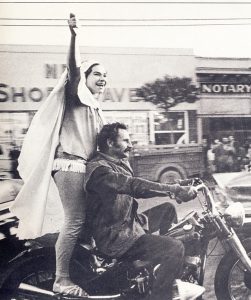
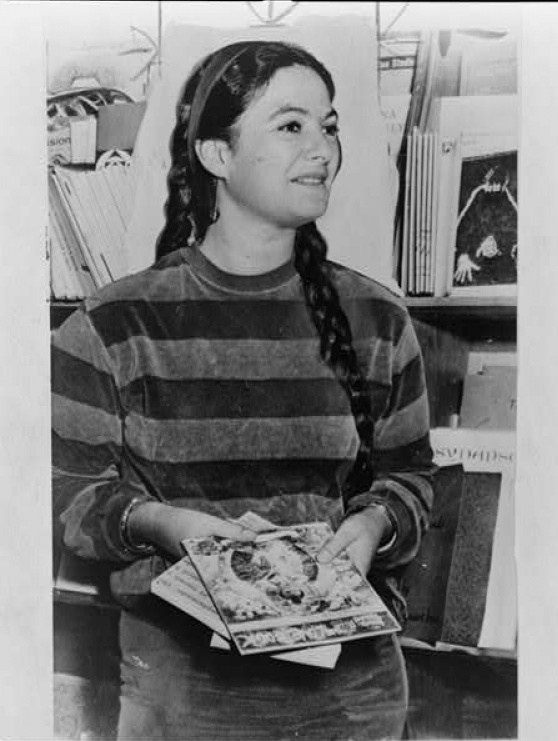
Diane di Prima on arriving in San Francisco in 1968 and getting involved with the Diggers/Free City

June 21, 1974: Diane di Prima reminisces and reads her work at The Poetry Center, San Francisco State University. Here’s a clip:

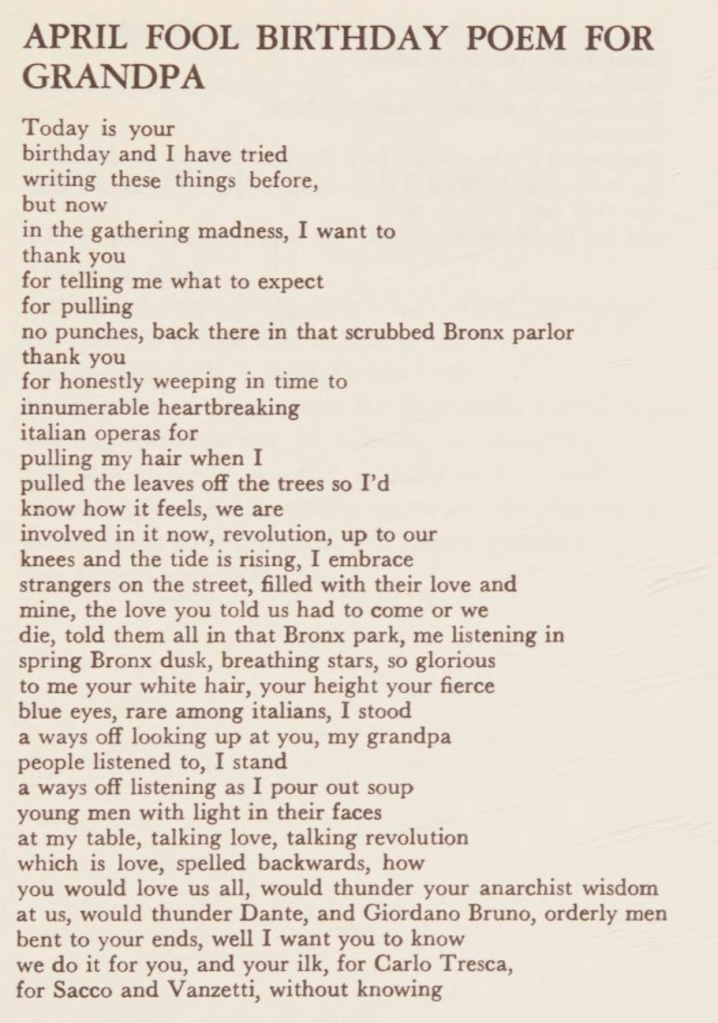
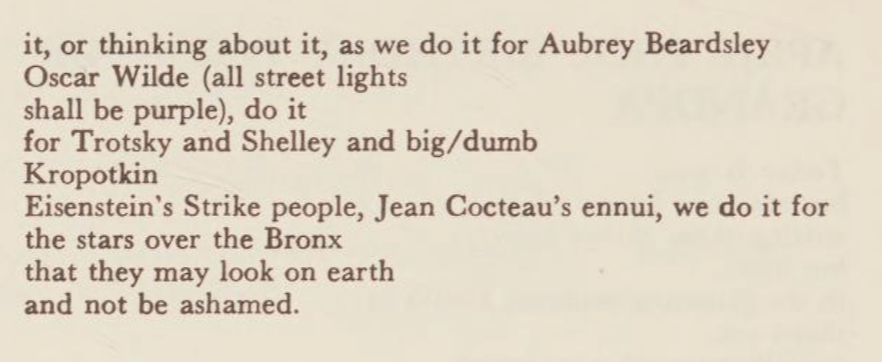
This is the text of the poem she reads, from Revolutionary Letters:

Full-program video (with downloadable audio) at Poetry Center Digital Archive: https://diva.sfsu.edu/collections/poetrycenter/bundles/239267

‘DIGGERS WELCOME’: A conversation with Nina Blasenheim and Freeman House

I interviewed two members of the San Francisco Diggers, Nina Blasenheim and Freeman (nee Linn) House, together at their home on California’s Lost Coast in August, 2010.

A little background for the uninitiated:

In 2026, the Diggers are little-known. But in 1966-8, such was the Diggers’ presence and notoriety that seemingly every reporter filing a story on the Haight included the Diggers in their account. “A band of hippie do-gooders,” said Time magazine. “A true peace corps,” wrote local daily newspaper columnist (and future Rolling Stone editor) Ralph J. Gleason. The Beatles’ press officer Derek Taylor would later write, “[The Diggers] were in my opinion the core of the whole underground counterculture because they were our conscience.”

So, as the counterculture came into being, the Diggers were there, the Diggers were important, the Diggers were well-known, but crucially, though they acted in public, the Diggers were anonymous. Nobody knew who they were, where they came from, or how they did what they did. In short, they had a mystique: a group of LSD-fueled street anarchists with a philosophy/practice of “everything is free / do you own thing.”

A couple years ago I came across this March 1967 article from the Foghorn, a student newspaper published by the University of San Francisco, a private Jesuit school, that summed up the Diggers vibe succinctly:

The sign on the door said, “You are a digger.” About 50 people had accepted the invitation and moved into the house high in the hills over the Haight-Ashbury.

A cauldron of stew was cooking in the kitchen. The stew, eventually, would be trucked down to the Panhandle, free for anyone with a bowl and a spoon. No one know for sure who brings the food that goes into the stew. Some is donated, some bought, some stolen. The stew would be good today; someone had brought two chickens.

It’s all the work of the Diggers, a mysterious, amorphous group in the Haight-Ashbury dedicated to given things away free and “doing their thing.” They have been evicted from more than half a dozen flats, apartments, and store fronts in the six months of their existence in San Francisco.

One place of refuge is the All Saints Episcopal Church on Waller, where Father Leon Harris has let the Diggers use his church kitchen to prepare the food for the Panhandle for three weeks now.

“The Diggers are industrious, cheerful and benevolent,” he said. “They also give away free clothing and find lodging for homeless people. It seems to me they put a lot of professing Christians to shame by their goodness.”

The conversation with Nina and Freeman in 2010 was the third serious Diggers interview I had conducted in less than 18 hours. Reviewing the recording later, I could tell that although my enthusiasm for the subject was undimmed, fatigue had set in and my lines of questioning and follow-ups were not as solid as they should’ve been.

But it’s still Nina and Freeman, together. What a joy to be in the presence of these two big minds, as they ribbed each other and made each other laugh, as they mulled over memories and tried to come to some sort of understanding about how it all happened the way that it did, and what it might possibly mean. When I walked through their door, they told me they had just been talking together about why exactly interest in the Diggers kept coming around, even after all these years. They seemed genuinely puzzled, and for a few minutes, it was me who was being interviewed about what the answer might be.

Our conversation flowed, with some stops and starts and many detours as they examined the Diggers-related documents that I’d brought along as conversation/memory prompts. Editing this conversation into a satisfying beginning-to-end piece like some of the other oral histories on this site was always going to be a challenge, and it wasn’t until recently, all these years later, that I finally understood that this simply isn’t that kind of piece. It’s something else, which is fine.

Continue reading “‘DIGGERS WELCOME’: A conversation with Nina Blasenheim and Freeman House”

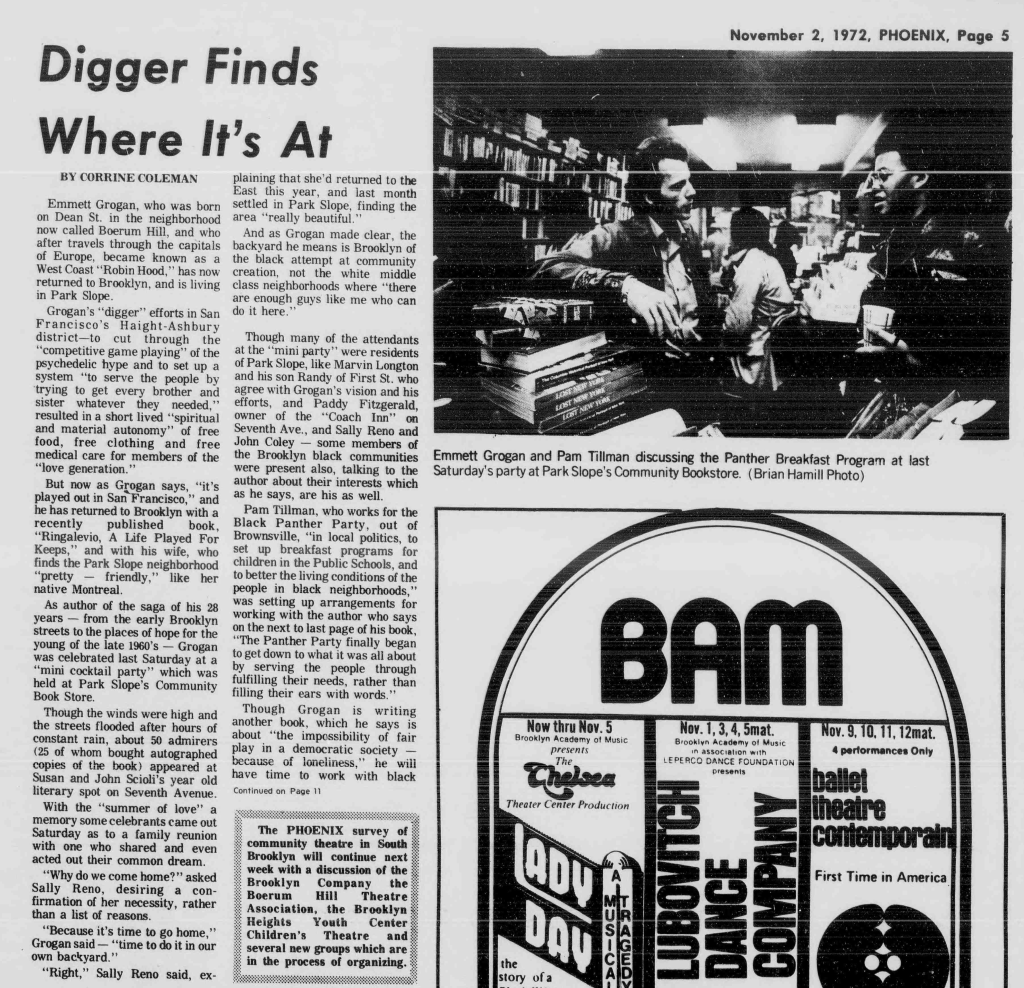
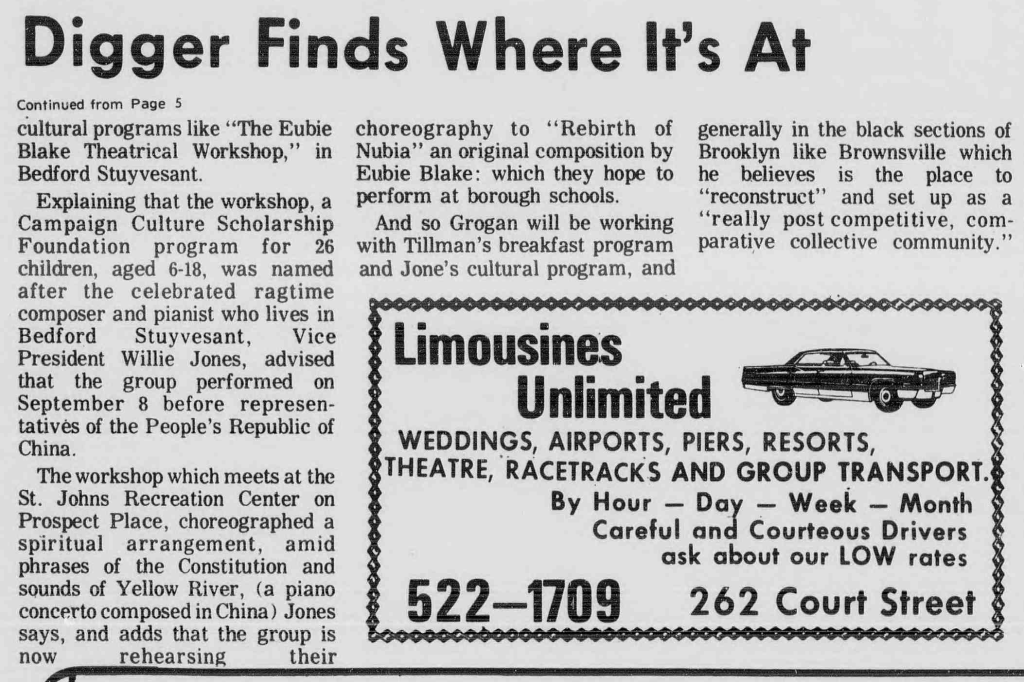
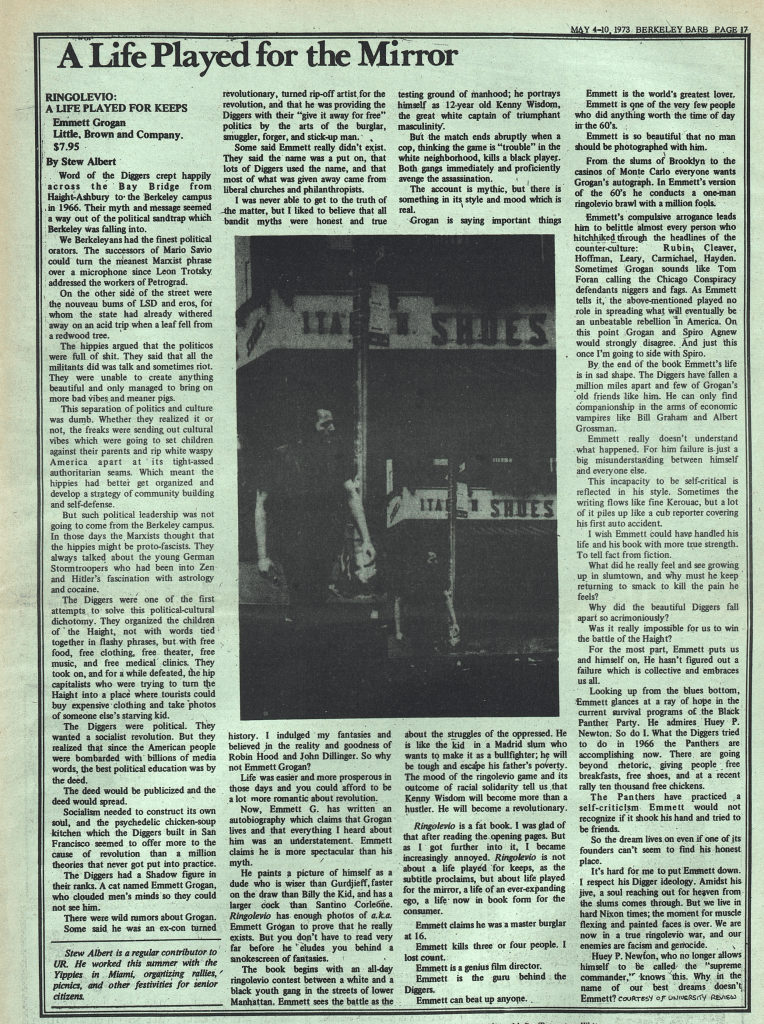
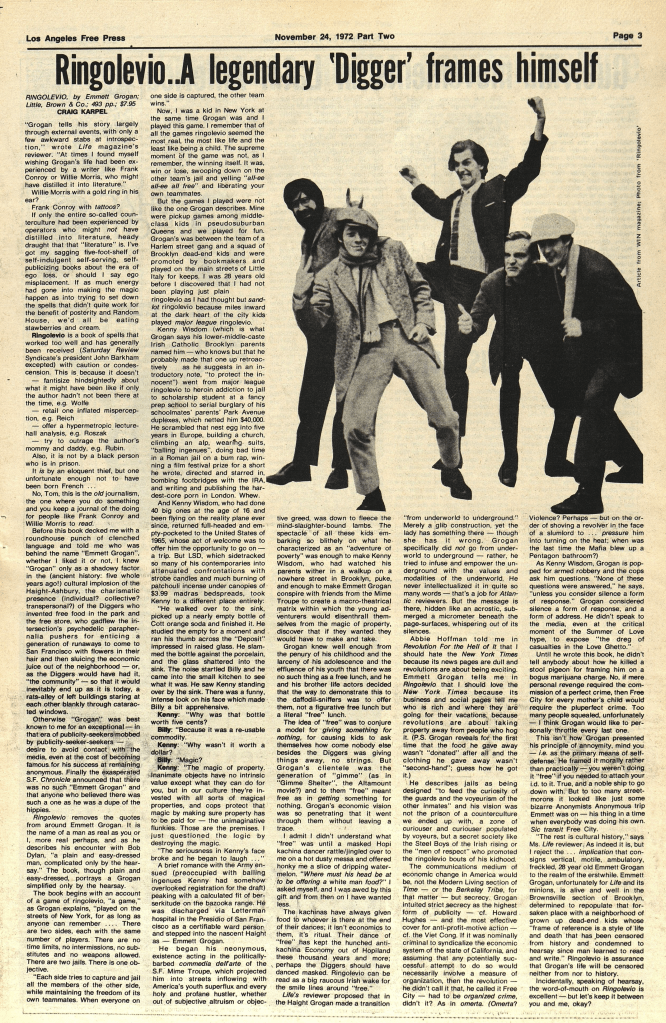
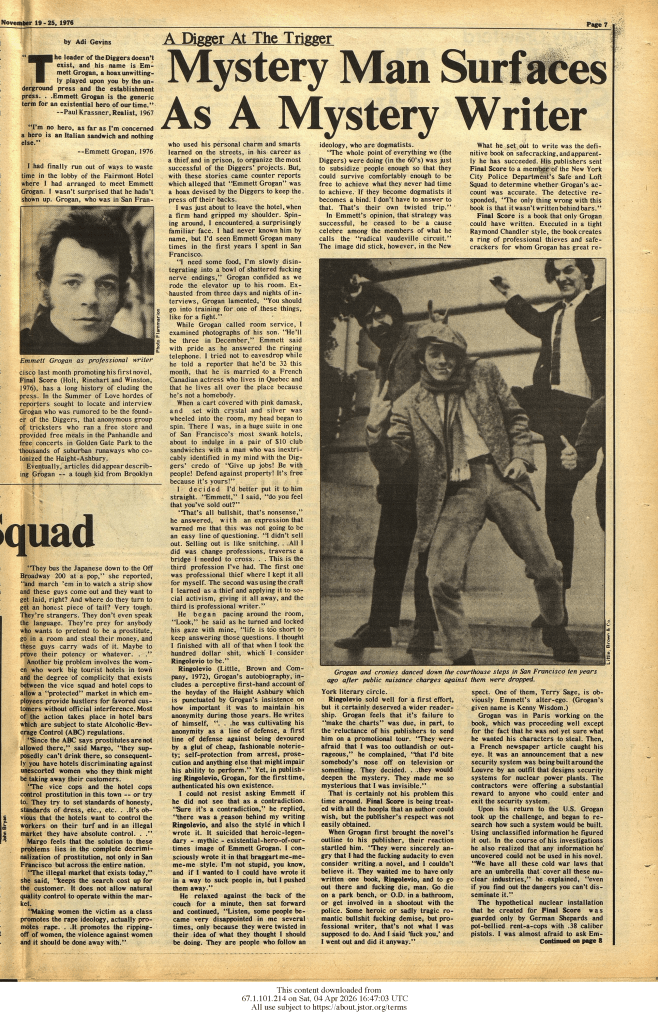
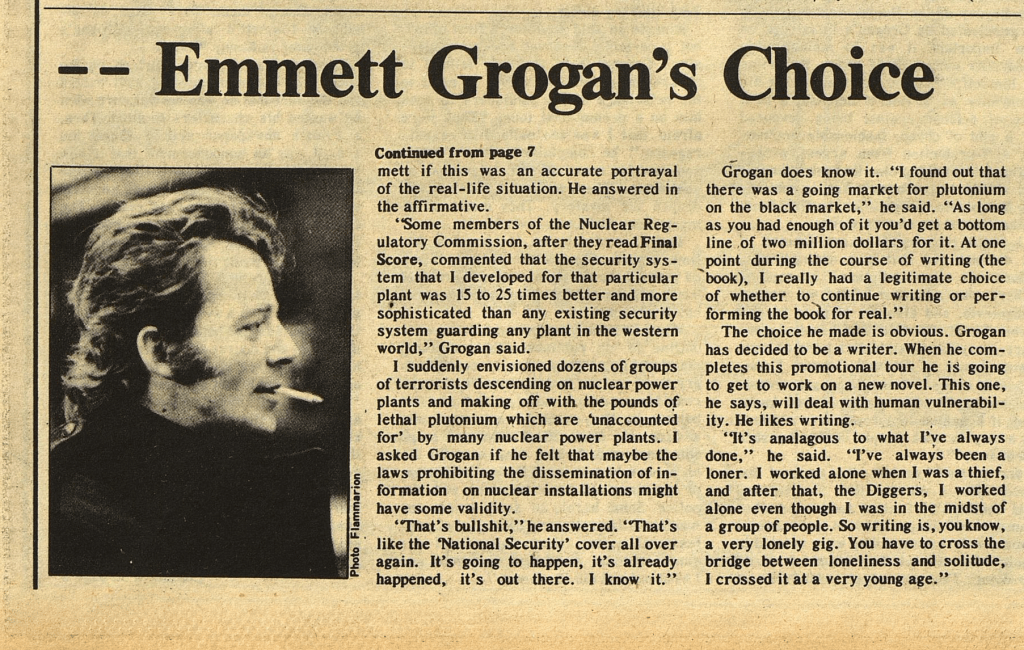
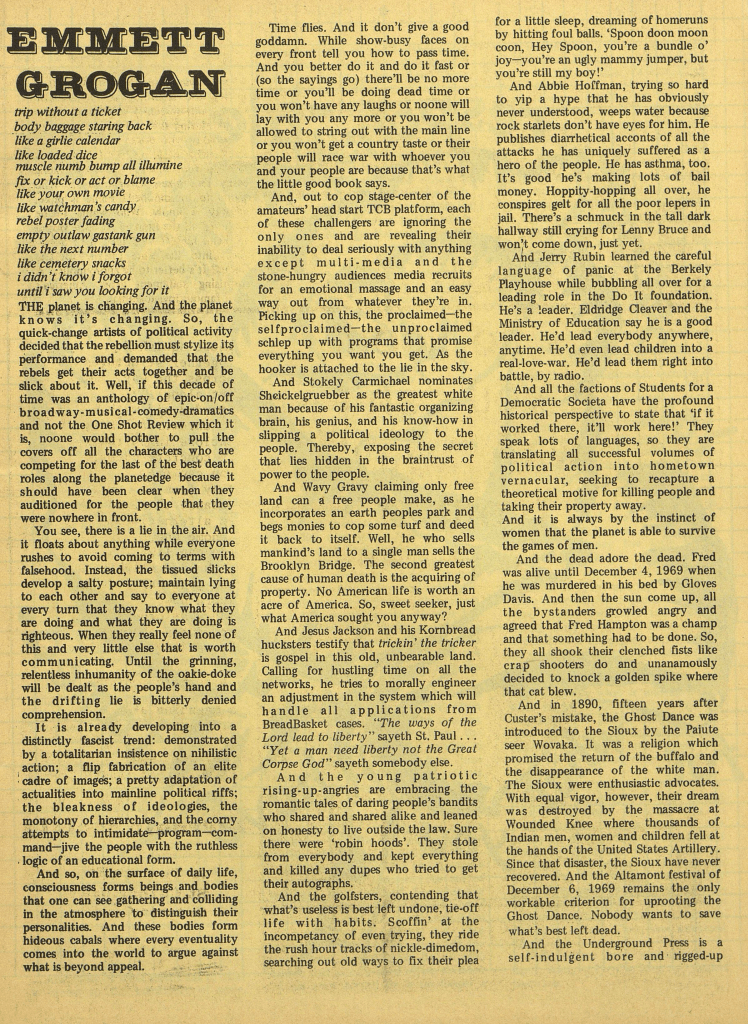
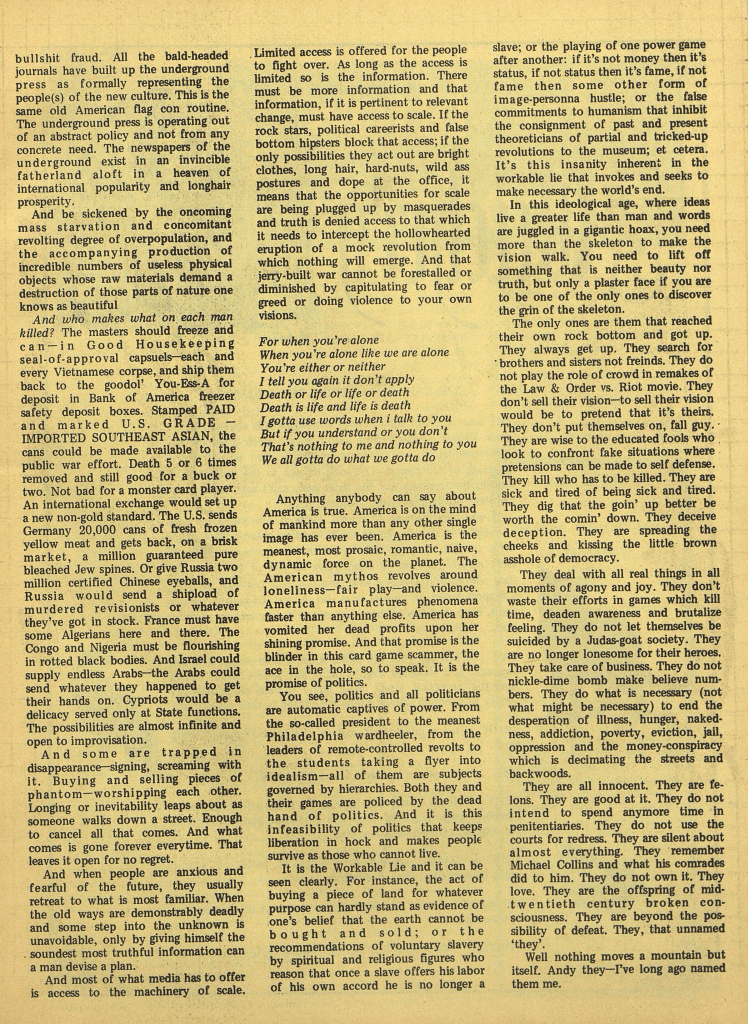
FAST LIFE: A previously uncirculated 1972 interview with Emmett Grogan by Linda Gaboriau

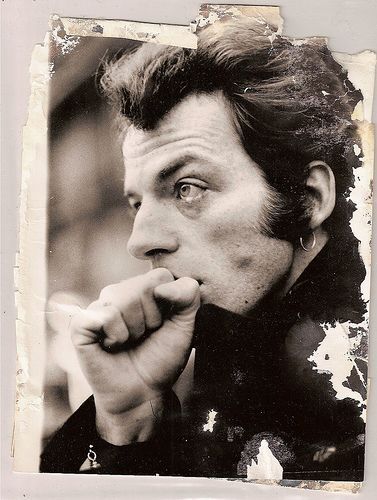
Emmett Grogan, from sometime in the ’70s. Photographer unknown. Courtesy Max Grogan.

Sometime in 1972, or possibly 1973, freelance journalist Linda Gaboriau conducted an interview with San Francisco Diggers member Emmett Grogan in the Montreal apartment he shared with his wife, actress Louise Latraverse. The conversation, which centered on Grogan’s recently published 498-page third-person autobiography-novel Ringolevio (also: archive.org), was apparently intended for broadcast on CBC radio, which Gaboriau regularly contributed to.

(Note: It is possible that each of the above statements is factually inaccurate or incomplete. I will update this post as/if I get any new information.)

I don’t know if any or all of this interview was in fact ever broadcast. Some years ago, a member of the Grogan family passed me an audio transfer of the interview, which had been recorded on ⅛-inch tape. The family has recently given me permission to circulate the interview’s contents here. With assistance from longtime Diggers archivist Eric Noble, I created a transcript from the audio file a couple of months ago, and what follows below is a transcript, which I have lightly edited for clarity. Any errors in transcription or editing are mine.

Continue reading “FAST LIFE: A previously uncirculated 1972 interview with Emmett Grogan by Linda Gaboriau”

Previously unpublished 1998 Lenore Kandel interview unearthed

“Come on, get used to it. Loosen up. You must liberate!”: Lenore Kandel (as quoted by Peter Berg in 2006) holding a copy of her Love Book.

Diggers.org archivist Eric Noble has posted the text of a previously unpublished 1998 interview with Lenore Kandel.

A very small portion of this hour-plus interview, conducted by French filmmakers Alice Gaillard and Céline Deransart, was used in their documentary Les Diggers de San Francisco. The remainder of the conversation has now been transcribed and edited for clarity and is now online. (I helped with some editing.) Go here to read it: https://diggers.org/lenore_kandel.htm

Lenore Kandel was a visionary poet, famed author of the controversial ‘holy erotica’ ‘The Love Book,’ an accomplished belly dancer and folk musician, the only female speaker at the Human Be-In (which occurred on her 35th birthday), and by many accounts, a major, imaginative, persistent force within the Diggers and the Haight scene in general, especially during the crucial 1966-1968 period. (Eric argues that it’s Lenore’s repeated, public use of “Love” that gave the “Love Generation” its name… I don’t know if I’m persuaded on that count [yet], but it’s possible!) She was involved in the early ’60s with Beat poet Lew Welch (they both appear, thinly fictionalized, in Jack Kerouac’s semi-autobiographical 1962 novel, Big Sur); published countless poems in small press magazines, chapbooks and the 1967 Grove Press collection, Word Alchemy (a posthumous 2012 collection of her complete poetic output is in print); appeared with boyfriend/Digger/Hells Angel Bill ‘Sweet William’ Fritsch in Kenneth Anger’s ‘Invocation of My Demon Brother‘; and, along with many other Diggers, was a featured poet at The Band’s ‘The Last Waltz’ concert.

An endearingly gentle-ecstatic Lenore Kandel reads a fresh poem at The Band’s The Last Waltz concert, Nov. 25, 1976.

Untreated injuries resulting from a 1970 motorcycle accident caused Lenore severe pain for the rest of her life; by the ’90s, when this interview was conducted, she was essentially homebound — but, as you will read, she remained intellectually alive, articulate and learned, playful and joyful. There are so many lovely passages in this interview. Yes, I wish Lenore had talked about her own family background, Fritsch, Hells Angels, all the incredible Diggers women, Diane di Prima, Emmett Grogan, Lew Welch, and on and on—but I am so grateful for what is here. 

On a personal note, I had hoped to interview Lenore regarding the Diggers in 2006 with my documentary filmmaking partners; however, when I contacted her, she was in one of her periods when she was feeling unwell. She asked me to call back. In 2009, as my partners and I started to prepare a second trip to northern California to conduct further interviews, Lenore was at the top of our list. Before I called her to try and schedule, I did a quick Google search, and was saddened to learn that she had passed away the previous week.

Everyone that I subsequently interviewed about the Diggers talked about Lenore with great fondness, especially Phyllis Wilner and Vicki Pollack. (Peter Berg and Kent Minault also shared some vivid memories of her brilliance.) Unfortunately, there is almost no record—in print or otherwise—of Lenore herself talking at much length about the Diggers. So, I am especially happy that Alice and Celine shared the unexpurgated footage of their interview with Lenore with Eric—and that he has now made it available to everyone. Love wins.

 Go here to read the interview: https://diggers.org/lenore_kandel.htm

Lost 1998 Arthur Lisch interview brought to light

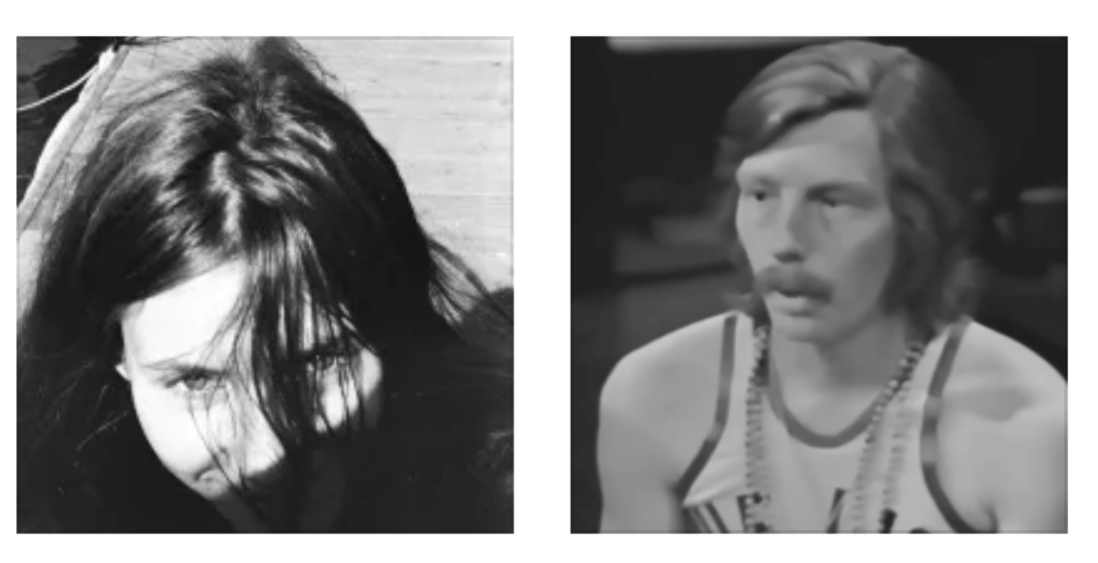
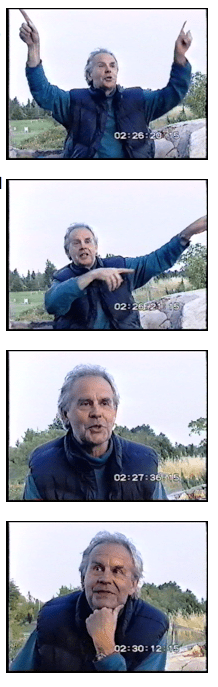
Stills from the 1998 interview.

Longtime Diggers archivist/historian Eric Noble has posted an edited transcript of a previously unpublished/unseen interview with Arthur Lisch, conducted in 1998 by filmmakers Alice Gaillard and Céline Deransart for their documentary film Les Diggers de San Francisco, released that same year.

For whatever reason, none of the footage from the interview made it into Les Diggers’ final edit.

Lisch, a lifelong artist-activist who played a major role in the Diggers’ activities, died in 2020. This is the only interview that I’m aware of where he reflected on the Diggers period at any length. I am so grateful that Eric was able to recover it, and it was my privilege to assist in the transcribing and (minor) editing.

Read the interview here: Arthur Lisch – Interview by Alice Gaillard and Céline Deransart, 1998