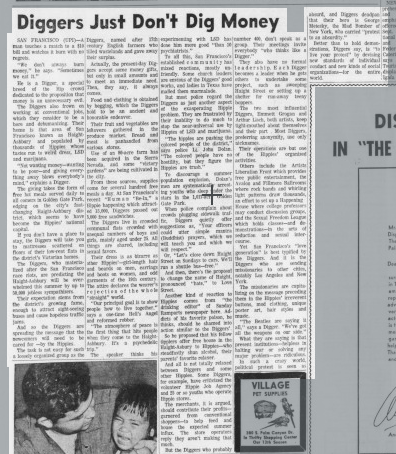
Diggers Just Don’t Dig Money
Desert Sun, Volume 40, Number 195, 20 March 1967
SAN FRANCISCO (UPI)-A man touches a match to a $10 bill and watches it burn with no regrets.
“We don’t always burn money,” he says. “Sometimes we eat it.”
He is a Digger, a special breed of the Hip crowd dedicated to the proposition that money is an unnecessary evil.
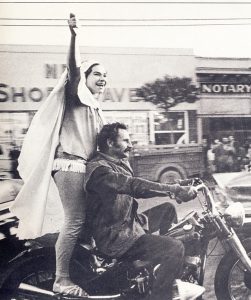
The Diggers also frown on working at conventional jobs, which they consider to be a bore and dehumanizing. Their home is that area of San Francisco known as Haight-Ashbury and populated by thousands of Hippies whose tastes run to weird dress, LSD and marijuana.
“Not wanting money—wanting to be poor—and giving everything away blows everybody’s mind,” explains a Digger.
The giving takes the form of free hot meals served daily to all comers in Golden Gate Park, edging on the city’s fast-changing Haight-Ashbury district, which seems to have become the Hippies’ national capital.
If you don’t have a place to stay, the Diggers will take you to mattresses scattered on floors of their low-rent flats in the district’s Victorian homes.
The Diggers, who materialized after the San Francisco race riots, are predicting the Haight-Ashbury will be overwhelmed this summer by up to 50,000 jobless sympathizers.
Their expectation stems from the district’s growing fame, enough to attract sight-seeing buses and cause hopeless traffic jams.
And so the Diggers are spreading the message that the newcomers will need to be cared for—by the Hippies.
The task is not easy for such a loosely organized group as the Diggers, named after 17th century English farmers who tilled wastelands and gave away their surplus.
Actually, the present-day Diggers accept some money gifts, but only in small amounts and to meet an immediate need. Then, they say, it always comes.
Food and clothing is obtained by begging, which the Diggers hold to be an ancient and honorable endeavor.
Their fruit and vegetables are leftovers gathered in the produce market. Bread and meat is panhandled from various stores.
Use of an 80-acre farm has been acquired in the Sierra Nevada, and some “victory gardens” are being cultivated in the city.
From these sources, supplies come for several hundred free meals a day. At San Francisco’s recent “Human “Be-In,” a Hippie happening which attracted 15,000, Diggers passed out 5,000 free sandwiches.
The Diggers live in crowded communal flats crowded with unequal numbers of boys and girls, mainly aged under 25. All things are shared, including sexual favors. Their dress is as bizarre as other Hippies’—girl-length hair and beards on men, earrings and boots on women, and odd garments of the 19th century. The attire declares the wearer’s rejection of the whole “straight” world.
“Our principal goal is to show people how to live together,” says a one-time Hell’s Angel and reformed robber. “The atmosphere of peace is the first thing that hits people when they come to the Haight-Ashbury. It’s a psychedelic trip.”
The speaker thinks his experimenting with LSD has done him more good “than 10 psychiatrists.”
To all this, San Francisco’s established community has mixed reactions, mostly unfriendly. Some church leaders are envious of the Diggers’ good works, and ladies in Texas have mailed them marmalade.
But most police regard the Diggers as just another aspect of the exasperating Hippie problem. They are frustrated by their inability to do much to stop the near-universal use by Hippies of LSD and marijuana.
“The hippies are pushing the colored people of the district,’ says police Lt. John Dolan. “The colored people have no hostility, but they figure the Hippies are trash.”
To discourage a summer population explosion, Dolan’s men are systematically arresting youths who sleep under the stars in the 1,017-acre Golden Gate Park.
When police complain about crowds plugging sidewalk traffic, Diggers quietly offer suggestions as, “Your officers could utter simple mantra (Buddhist) prayers, which we will teach you and which we will respect.”
Or, “Let’s close down Haight Street on Sundays to cars. We’ll run a shuttle bus—free.”
And then, there’s the proposal to change the name of Haight, pronounced “hate,” to Love Street.
Another kind of reaction to Hippies comes from “the drinking editor” of Sunday Ramparts newspaper here. Addicts of his favorite poison, he thinks, should be shamed into action similar to the Diggers’.
So he proposed that his fellow tipplers offer free booze in the Haight-Ashbury to Hippies—who steadfastly shun alcohol, their parents’ favorite relaxer.
And all is not totally relaxed between Diggers and some other Hippies. Some Diggers, for example, have criticized the volunteer Hippie Job Agency and 25 or so youths who operate Hippie stores.
The merchants, it is argued, should contribute their profits— garnered from conventional shoppers—to help feed and house the expected summer influx. The store operators reply they aren’t making that much.
But the Diggers, who probably number 400, don’t speak as a group. Their meetings invite everybody “who thinks like a Digger.”
They also have no formal leadership. Each Digger becomes a leader when he gets others to undertake some project, such as sweeping Haight Street or setting up a shelter for run-away teeny hoppers.
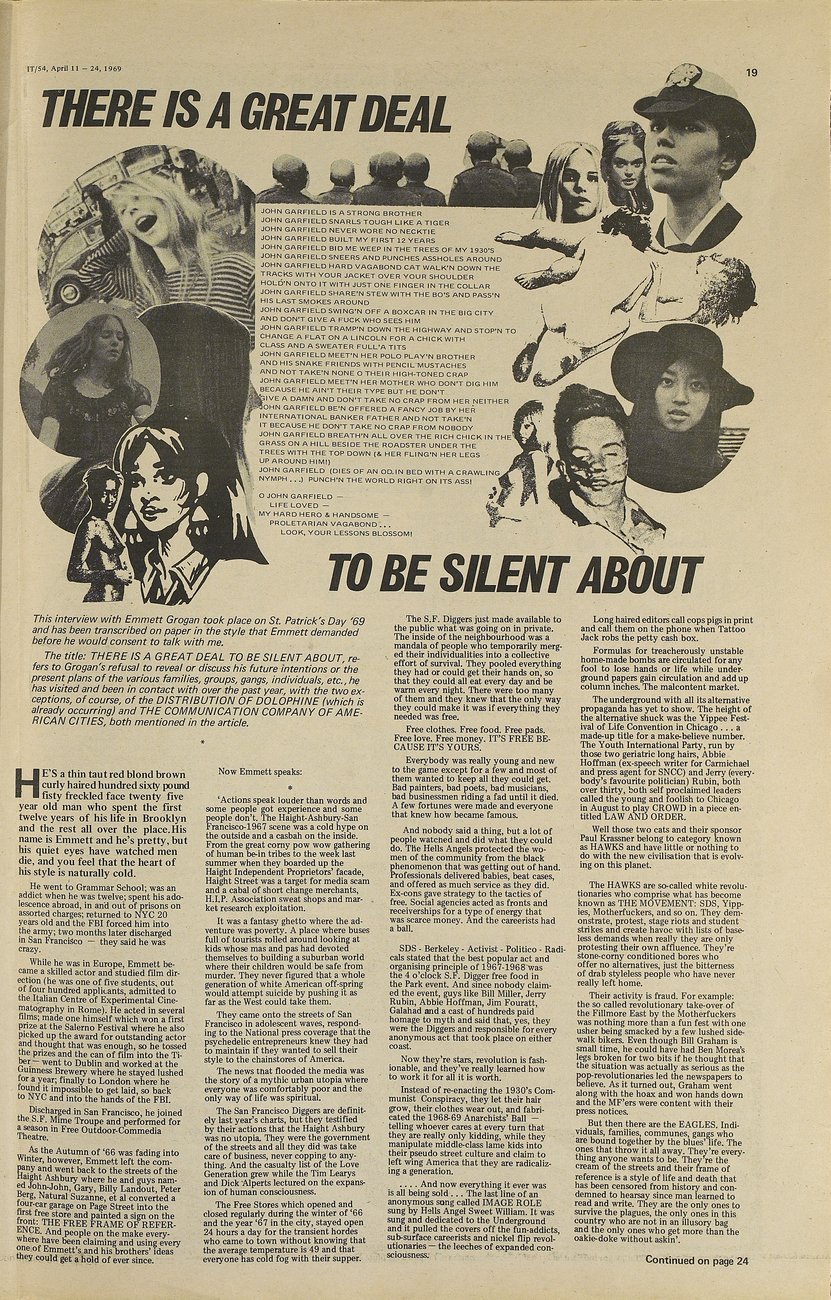
The two most influential Diggers, Emmett Grogan and Arthur Lisch, both artists, keep tight-mouthed about themselves and their part . Most Diggers, preferring anonymity, use only nicknames.
Their operations are but one of the Hippies’ organized activities. Others include the Artists Liberation Front which provides free public entertainment, the Avalon and Fillmore Ballrooms where rock bands and whirling light patterns draw thousands, an effort to set up a Happening House where college professors may conduct discussion groups, and the Sexual Freedom League which holds classes—and demonstrations—in the arts of seduction and sexual intercourse.
Yet San Francisco’s “love generation” is best typified by the Diggers. And it is the Diggers who are sending missionaries to other cities, notably Los Angeles and New York.
The missionaries are capitalizing on the message preceding them in the Hippies’ irreverent buttons, mod clothing, unique poster art, hair styles and music.
“The Beatles are saying it all,” says a Digger. “We’ve got all the weapons on our side.”
What they are saying is that present institutions— helpless in halting war or solving any major problem—are ridiculous.
In such a crazy world, political protest is seen as absurd, and Diggers deadpan that their hero is George Metesky, the Mad Bomber of New York, who carried “protest to an absurdity.”
Better than to hold demonstrations, Diggers say, is “to live your protest” by devising new standards of individual conduct and new kinds of social organizations—for the entire world.

 Diggers Docs