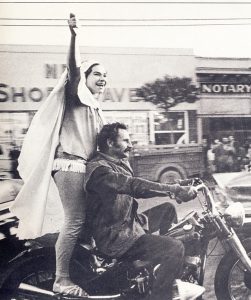
I interviewed Nina Blasenheim and Freeman (nee Linn) House together at their home on California’s Lost Coast in August, 2010. It was the third serious Diggers interview I had conducted in less than 18 hours and listening to the recording later, I could tell that although my enthusiasm for the subject was undimmed, fatigue had set in and my lines of questioning and follow-ups were not as solid as they should’ve been.
But it’s still Nina and Freeman, together. What a joy to be in the presence of these two big minds, as they ribbed each other and made each other laugh, as they mulled over memories and tried to come to some sort of understanding about how it all happened the way that it did, and what it might possibly mean. When I walked through their door, they told me they had just been talking together about why exactly interest in the Diggers kept coming around, even after all these years. They seemed genuinely puzzled, and for a few minutes, it was me who was being interviewed about what the answer might be.
Our conversation flowed, with some stops and starts and many detours as they picked through the many Diggers-related documents that I’d brought along with me as conversation/memory prompts. Editing the conversation into a satisfying beginning-to-end piece like some of the other oral histories on this site was always going to be a challenge, and it wasn’t until recently, all these years later, that I finally understood this simply isn’t that kind of piece. It’s something else, which is fine.
Read more: ‘DIGGERS WELCOME’: a conversation with Nina Blasenheim and Freeman House (2010)Freeman died in 2018, at age 80. A concise biography of his remarkable life and work is available via Empty Bowl Press, who in 2023 published a posthumous collection of Freeman’s marvelous bioregionalist work entitled A Watershed Runs Through You: Essays, Talks, and Reflections on Salmon, Restoration, and Community, thoughtfully edited by author/poet Jerry Martien.
This is the eleventh interview in my series of Diggers’ oral histories; the others are accessible here. For more detailed information on the Diggers, consult Eric Noble’s vast archive at diggers.org
I have incurred not insignificant expenses in my Diggers research through the years. If you would like to support my work, please donate via PayPal or Buy Me a Coffee or Venmo. All contributions, regardless of size, are greatly appreciated. Thank you!
— Jay Babcock (babcock.jay@gmail.com), April 12, 2026
The “interview” starts mid-conversation. I’d mentioned my theory that 1966-7 in San Francisco was some kind of “rupture” moment in history, when some unpredictable, radical cultural formation had a chance to emerge, incubate and break through into the larger culture, akin to the Paris Commune of 1871, or the French Revolution of 1848, or the anarchist movement in Spain in the late 1930s.
Jay Babcock: …The other thing about the Diggers that sets them apart is that unlike the other movements of the time, they weren’t populated by activists. They were poets, actors, writers, dancers, artists —
Freeman House (F): Petty thieves.
Nina Blasenheim (N) (correcting): Major thieves.
F: The Diggers made it a point not to engage in social issues of the time. The way the Diggers engaged in the Vietnam War, for instance, was to hold a big event called The War Is Over. And they had fun doing it.
But the word ‘rupture’ I really like a lot. I mean, that’s my experience. At the time, in the world, it was just like a rupture in history, where you could declare the world is such-and-such a way and act it out — which is, in my mind, what the Diggers spent their time doing.
Living the way you wanted to live, rather than protesting to be given the right to live the way you want to live...
F: Right. You didn’t ask for anybody to do things that you thought you should be doing, you went ahead and did them. That’s what was exciting about that period of time for me.
You were in New York when the Diggers were getting going.
F: I was in New York until ’67.
N: He’s one of the few people who’s a Californian but he went to New York for a couple of years.
F: Bay Area. My father was a carpenter, my mother was a housewife. Two brothers, one sister. Very suburban, very constricted feeling. I mean, they weren’t particularly restrictive, it was just: Life felt restricted in that milieu. After I left their home, I wandered around for several years trying to figure what the fuck it was all about.
N: He came of age in the ‘50s, and I came of age in the ‘60s. Very different thing.
F: I spent a year at Oregon, it was called Oregon State College at the time. Then I went to UC Berkeley for five or six years. I could never quite decide [what to study]. I came within a year of degrees in English, Dramatic Arts, and Education. I had to decide on what my curriculum would be for my last year and I suddenly realized that any one of those curriculums was preparing me to do nothing but teach, which was the one thing I was sure I didn’t want to do. [laughs] I wasn’t sure of much else. I was pretty sure of that. I’m a shy person. I was especially shy then. And felt like I’d had a lousy education, even though I came up at a time when California had the number one educational system in the country. And it didn’t make all that much difference. I still didn’t feel like I was an educated person. But I enjoyed hanging around schools a lot.
I ended up in New York, taking a lot of acid. And for the ten years preceding that, kind of faking my way upward in the restaurant business, until I became chef of the first Maxwell’s Plum on the Upper East Side. It was a pretty high-class place, which now, it’s a bit of a shame, I think. But anyway, I’d go home and read cookbooks at night, bluff my way through the next day. I went to work loaded on acid one day and that was my last day in the restaurant industry. ’64, ’65.
N: We were both in New York during the Northeast blackout [of 1965]. I was there as an Antioch student. He was there when I was there.
F: ’65. Might have been there a year by then.
N: We didn’t meet each other, we just happened to both be there.
F: We met when I came to San Francisco. [continuing] And at that point, I was convinced that LSD was gonna save the world.
N: He had a magazine.
F: This was while LSD was still legal. The streets were flooded with drugs, and only a few of them were good in a pharmaceutial sense. Nobody knew anything about them. There was no way to get any information about them. So I decided to form this sort of informative, sort of tongue in cheek periodical called Inner Space, which lasted for about five issues. I just got bored with it.
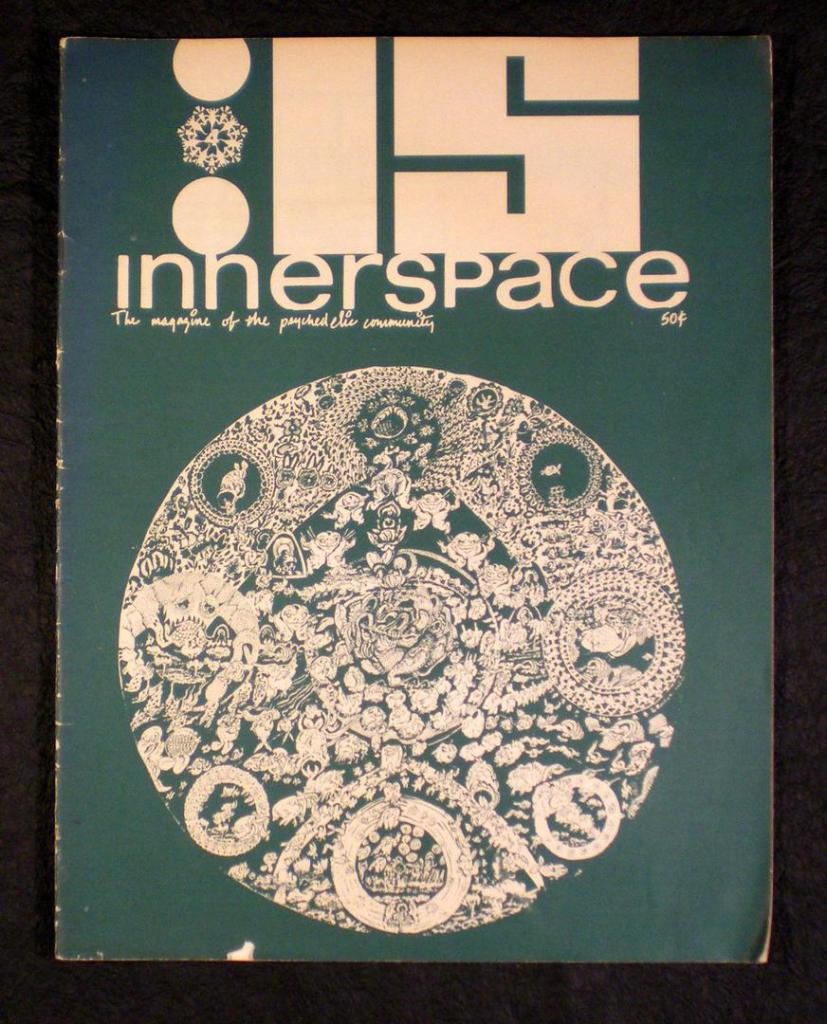
I’ve seen scans of it online, it’s really fascinating —
F (surprised): I’d assumed it had disappeared forever and just as well. [laughter] I have a couple because my mother kept them. It was poorly designed. That’s what I liked least about it.
Where were you living in New York?
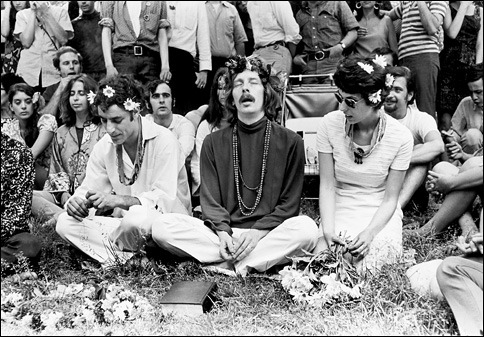
F: At the time I was doing that magazine,… well I was doing it at all the places that I lived in in New York. Started out in the Lower East Side, where I was supporting myself by ruining the kitchen in a little jazz club called Slug’s Saloon. East Fourth Street. That was fun. All the up and coming jazz luminaries of the day would come spend their breaks in the kitchen. People would divide up into the junkies in one corner and the speed freaks in another and the psychedelic people in another. I got a taste of everything! You had to keep the cook happy. [laughs] And then, I had a loft just a couple doors away from the [inaudible] hotel for a year or two. That’s interesting and the connection to [Nina’s] history because it was in that loft that the west coast Diggers sort of recruited the east coast Diggers, including Abbie Hoffman. That’s where I first met the San Francisco Diggers. And then a little later on, I lived way up on the East Side of New York.
N: You probably never lived anyplace for two years. [laughs]
F: Probably not. I was only there for two and a half years.
You were right there at an exciting time: the jazz scene, the folk scene —
F: Yeah, and the psychedelic scene.
Peace Eye Bookstore, the Fugs…
F: The Motherfuckers.
N: Me too, but from a whole other angle. I grew up in Queens and then on Long Island. Jewish red diaper baby.
So many Jews in all of this…
F: No other culture. [laughs]
Wait, Freeman, was your family Jewish too?!
N: No, but most of his partners have been. [laughter]
F: I’m a devotee of Jewish women. [laughter]
N: My father was a mechanic. He was a working class guy. He was a communist, ’til 1955. He was a merchant marine. He was part of that. He actually got blacklisted, even as a working class guy. And he had to go back to sea. Then there was a whole thing with him an the merchant seamen.
But I grew up not knowing anything of this, because my mother especially was totally freaked out. Until I got political myself, which was when I was about 12, [then] my mother told me these stories. My mother was a housewife. Three kids. My youngest sister was born accidentally at home and ended up being mentally retarded. So [my mother] was home, longer. She was a mother for a longer period of time. But she had been a union person and probably had the most fun during the War. Did some theater.
During the war my father was in the merchant marine. My father wanted to go and fight Nazis.
Then we lived in Mexico for a year, Mexico City. My uncle lived here and he did construction, and my father wanted to do something different. We moved to Mexico City and he worked for my uncle. All the interesting people in Mexico City were ex-pats, and most of them lefties. My uncle was totally into making money, had nothing communist about him. People were artists there, he liked that world. That’s who he’d grown up with. That’s what his all family was like. They grew up in a Orthodox Jewish family and they all went the other direction.
My uncle ended up getting deported from Mexico. And we left quickly. We moved back to New York. I was 10. It was very eye-opening to me to see… That’s probably why I got political. Because of the poverty [in Mexico], and being an American [there], and being privileged. I just had never known that because I was totally a working class person. Then my parents for some reason sent me to this left-wing camp. If they didn’t want me to be involved in that, why’d they send me there? But it sort of made me realize that I’d found my people. I was political really young. Just being interested, reading all sorts of stuff. I used to enjoy reading the Daily Worker on the subway. [laughter] 15 years old? I don’t know. [I was] Sassy.
And I used to go hang out in the Village. ’63, ’64. Then I went to Antioch in ’65. Antioch had these co-op jobs—you work, go to school, work, go to school. So my first job was in New York City and my later-on job was in San Francisco, mostly cuz I wanted to go there. That was in the fall of ’66. I came out to San Francisco with my hall advisor and some other people. We rented an apartment. And we were on the way back [to the apartment] when there were the riots in the Fillmore and in Hunter’s Point. [The news reports] didn’t say there was riots in the Haight Ashbury so, we didn’t know the neighborhoods, but the place we had rented was in the Haight. So we went to look at the tanks and within five minutes, we were arrested. [laughs] There was this big mass arrest, they were dragging people in off the porches in the Haight and all this kind of stuff. They basically just let it all drop [in the end], it just kind of all went away.
But—there was a big protest thing [after that]. And at this protest thing, Emmett [Grogan] was speaking. And Billy [Murcott]. And my hall advisor [Bobbi Swafford] thought that Emmett looked just like this guy she had a crush on at Antioch, and decided to go up and introduce herself and he said, [loudly]”YOU WANNA COOK?”
And so we cooked. Right there. First day of Diggerdom.
That thing, that was the first time there was gonna be food at the protest. They started printing out these things, these Digger things, putting them—not the big Digger papers, but just a little thing. ‘Digger Free Food,’ whatever. So yeah, we cooked. And then I ended up going to the produce market a lot.
Why did you do it?
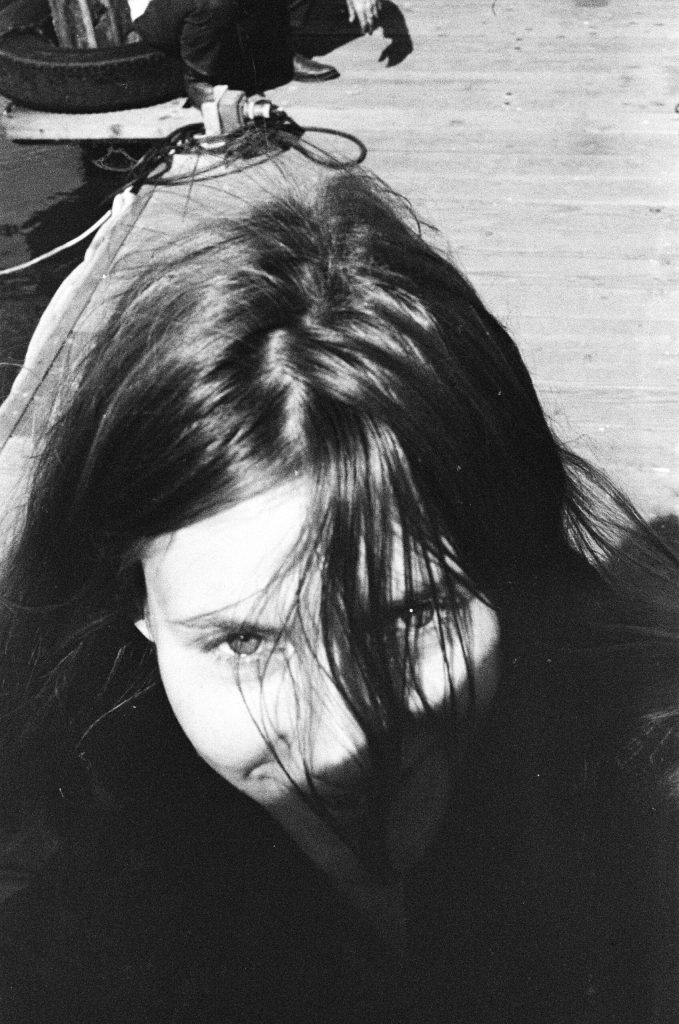
N: Why’d I do it? Because it was fun! Because I was sleeping with Emmett. [laughs] Along with everybody else. [laughs] Because I just thought it was interesting. Having grown up in a left-wing household with a parent who’s very, you know, all his ideas, he had lost his faith when the whole Stalin thing happened. He was very saddened by all of that. I could see all the different sides. If you were hanging out in Greenwich Village, the whole folk scene, the early folk scene, Washington Square Park and you’re just a kid, it just seemed interesting.
Also when I was in high school I went to camp with the Guthrie kids. I was friends with Nora Guthrie for a bit, for my last year of high school. And it turned out my father actually knew Marjorie’s husband, because, even though she still took care of Woody, they had been separated for a while. The man that she was living with, my father and him had been seamen together. All small little worlds here.
So when I hit San Francisco, it was just sort of interesting. I dropped out of Antioch—there didn’t seem any point [in continuing there] because I wanted to do this thing that seemed very alive. But I didn’t have a pre-thought… [Freeman] had. That’s the difference, being ten years older, he alreadyhad a rationale. I was just making it up, going with the flow. ‘Hmm, this looks like a good thing.’
And I had taken acid already too, at Antioch. Not hugely important to me. I mean, my first trip was amazing. It was important, but not hugely important.
So our house became one of the houses that [did the cooking]. There was a big milkcan that we cooked in, just sort of threw everything in there. Kent [Minault] and Brooks [Bucher] were sort of the main people to bring the food out to the park. With the Free Frame of Reference thing. The ‘Excess Express’ was a VW bus and had Blake’s “the Road of excess leads to the Palace of Wisdom.” And we were together, Kent and I were partners by that time. At some time. I don’t know. Time passed. By the time we were doing the food all the time, but not at first. I was 18. I went to Antioch when I was 17.
How big a deal was acid for what the Diggers were doing, collectively?
N: There was just individuals who took a bunch of acid, but I don’t think the Diggers were particularly… But then those guys just ended up getting into hard drugs, the whole heroin business. I don’t remember [acid] being a huge thing. Did anyone else think it was?
Yeah. Peter Berg —
N (shocked): Said it was?!? Did he ever take LSD? [laughs]
He said the period probably wouldn’t have happened without it.
N: Probably. That could very well be. It really was a mind-changer for me. [To Freeman:] Do you remember acid being very big in Diggerdom?
F: It was…
N: It was just sort of one of the things…
F: Well…
Did Emmett talk about it?
N: He probably tried it but I don’t think Emmett took acid very much.
F: I never thought of it just that way before. A few years earlier, LSD had been a thing unto itself, a world unto itself. By ’67, anyway, it was just one of the possibilities.
October, 1966 is when it goes illegal.
N: Right. That’s when there’s the big thing with Big Brother in the Panhandle. That was fun. [returning to the appeal of the Diggers] And it was just that idea, when you made everything free… The thing I always thought about ‘free’ was it being – when you have money, you don’t talk to people, you’re not involved, you’re just trading. You just exchange money: that’s how transactions take place between people. And right now we’re living in this world that is so totally money-centric. To me, that was what was so exciting about this. You’d just do it. Money didn’t mean anything at all.
And interesting things would happen.
N: Yeah. Because, there’s food, and people come and eat food, some people were starving, but we would go get food. We didn’t absolutely have to, but it was a way of being there, being with people. It opened up time. It just allowed people to do other things—to do whatever they felt like.
But it was also the time. I mean, you could get a flat in San Francisco that had seven bedrooms, which could end up having whatever amount of people in it, and it’d cost $125 a month. And you could just pay rent for a little while, and then you can move on. Also, when we went to the produce market, we presented ourselves there as being do-gooders. But there was TONS of food that they would’ve thrown out, and instead they saved for us. The younger girls that would go and flirt with the guys and then [laughs] they would just save us food.
Were you guys going down there every day?
N: I can’t even remember. Everything kind of morphed. I cooked for [the free food in the park], and then there was food that got distributed for a while. And [then there was] the bakery.
How did you figure out how to cook at such a volume?
N: We just threw everything in the pot. At some point there was a cook that came into the picture. Other people started doing it, like the Glide Church—that’s something that started back then that never stopped. They started serving food and then after we blew their minds with the Invisible Circus… Cecil Williams, he got into a lot of trouble with his constituents, but he just kept on going.
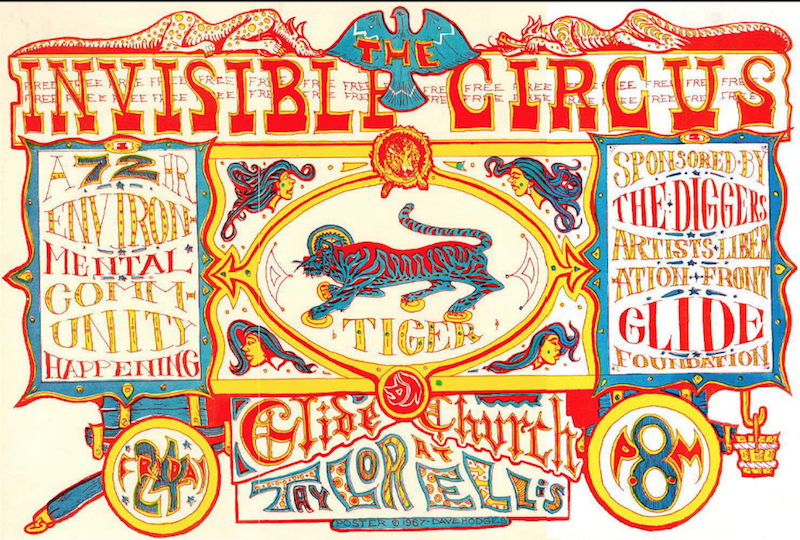
What are your memories of that?
N: The Circus was pretty outrageous. I had been on the street earlier doing some Mime Troupe PR with David [Simpson], and David let us use their costumes so I ended up going [to the event] in one of their Commedia dell’arte costumes. I walked in there and somebody pops some LSD in my mouth. The morning before, Emmett had delivered these chickens from Davis to their kitchen. This was before she met David. Jane [Lapiner] work up to chickens cackling in her kitchen because during the night Emmett had brought a lot of live chickens that had come from some Davis experimental [inaud], so I don’t know what the hell was in there, actually, to think of it. Kent and I, we offed them and plucked them and got them ready for serving at the Invisible Circus… It was probably the day before or something.
Then Kent was showing these porn movies.People just did whatever they wanted. There was a few things set up and the rest of it just however it went. People did their own thing. I don’t know, I just sort of hid after a while. [laughs] It was definitely being in another world there. It was right in the middle of the Tenderloin, so all the transvestites and street people were there. Everybody was there, Krassner was there, the one that started that Prostitutes Union, Margo St. James, she was dressed as a nun. There were people fucking on the altar. It was supposed to go on three days, it just lasted one night.
Freeman, how did you get from New York to San Francisco and the Diggers…
F: I was probably hearing rumors about them. Somebody sent the magazine a few copies of the Communication Company street papers, and I liked it so much that I put them in print. I think it was the first time they had ever been put in print. And they’re in one of those magazines. Then, somehow I took a trip to San Francisco and I saw the Free Store, I saw the Free Food, I met Peter Berg.
N: Which free store?
F: I think the one on Paige Street. Then I printed those things and then there started being a little correspondence and then a little troupe of Diggers came to New York, with the expressed interest in organizing a New York Diggers voice—which Abbie Hoffman quickly took over.
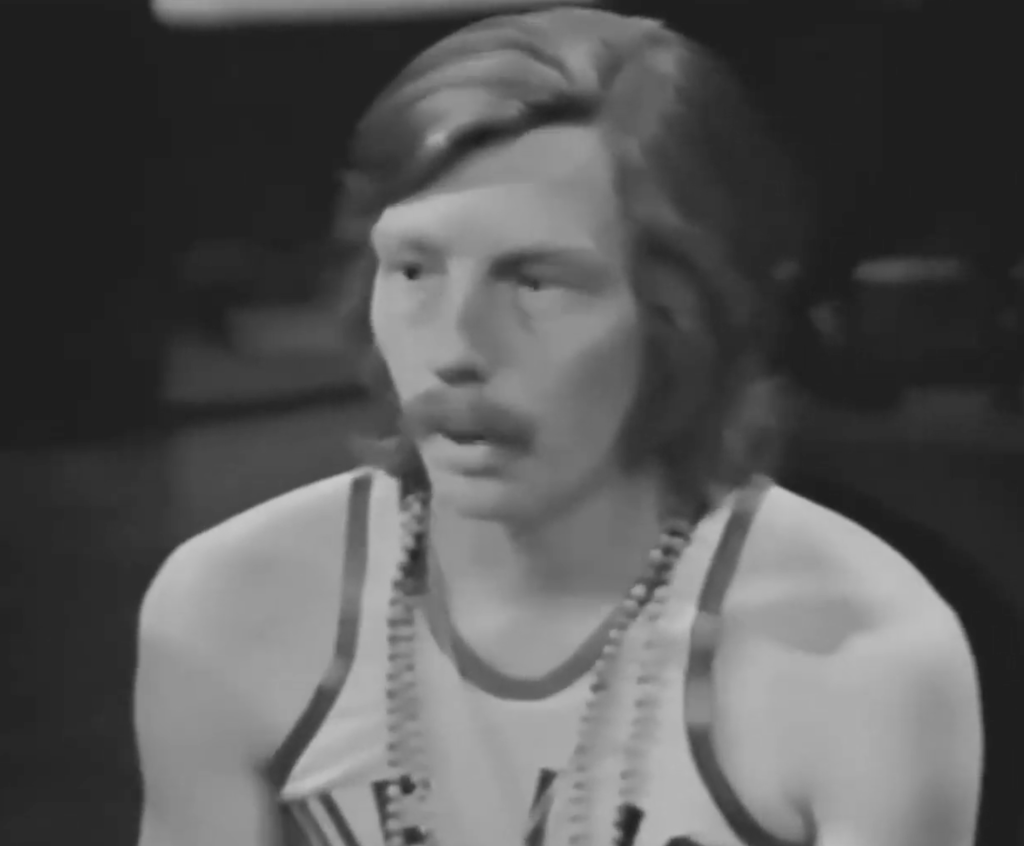
N: Which then became the big…whatever…between Emmett and Abbie.
F: Well, that evolved into Yippies, eventually. But I was hanging out with Abbie before that happened. Anyway, those meetings happened at the loft at 23rd Street, that’s where I met Emmett and probably…
N: Peter [Berg].
F: Peter was there. First time I ever saw Peter Berg… There was a popular television talk show… And Peter was on it, being interviewed, and I happened to be watching that show. I hardly ever watched television. And at one point in the interview Peter just walked off the stage, signaled the cameraman to follow him, and the cameraman did! And he just walked slowly out of the auditorium, having conversations with people as he went. He completely took the show away! I was very impressed. [laughter] That was right at the beginning of that trip. Those people hung around for a couple of weeks.
N: Phyllis, I think she was at the thing with Peter on television.
Freeman, did you know Chester Anderson in New York?
F: Chester Anderson is actually what got me from New York to San Francisco. Because I was doing this magazine, and we had this little informal distribution service. People were traveling all the time. Somebody’s going to Cleveland, [I’d give them a box of Inner Space to deliver] to a bookstore in Cleveland. And that’s the way all the distribution was done outside of New York City. Chester came and claimed to be in charge of the machines that were putting out the Communication Company’s papers. He said if I came to San Francisco, he would turn them over to me and we could produce this magazine on it and ‘grow this thing.’ Well, it took me about a month to get to San Francisco after that. But that’s what I was headed for, was those machines. When I got there, Chester Anderson hadn’t had those machines for probably a year. David was actually working them. That’s when I first met David. It was like the middle of the night and he was printing this set [holds up paper]. And he was printing them very, very slowly, so they’d get a good ink impression.

N: Where was he printing them?
F: Some warehouse somewhere, it was in a warehouse district. And he was just pacing around—
N: David paced, all the time.
F: —totally engrossed, looking at every impression. So. Yes. I’ve always enjoyed that story of Chester Anderson luring me to San Francisco with false promises.
N: Then you had, what was it, that house.
F: Oh, yeah, there was a place called Happening House, which was a Victorian on one of those cross streets between Haight and the Panhandle. A big Victorian. And it was set up as an educational system by this San Francisco State professor named Leonard Wolf. That was the first place I had to stay in San Francisco. And Leonard Wolf decided he was going to produce an event at the Straight Theater to educate the street kids about drugs. And in my opinion there wasn’t any group of people in the country who knew more about drugs than the street kids. [laughter] So this guy made the mistake of asking me and another fellow whose name I don’t remember to produce it. So we did. We didn’t tell him anything about what was on the agenda but we had a puppet show. There was a table with the experts behind it… It was a free event, the auditorium was packed. Then we set up a puppet show. Bill and Ann, who had the dirtiest Punch and Judy show I’d ever seen in my life, were between the audience and the experts. And they would make comments, to the experts. And they had the experts talking back to them in no time at all, arguing with them. [chuckles]
[looking at flyer] This is the first thing that David and Jane [Lapiner] and I did together. Jane was producing a dance performance, I believe was called Bodies, five or six naked dancers.
N: More I think. A bunch of women, a bunch of guys.
F: Not a lot more.
N: Whatever. Not 30.
F: Somehow the police got wind of this, the nude dancing, and they came into the foyer of this theater and somebody saw them and ran into the theater and said, ‘the cops!’ and the audience got up like, as a body, and hid the dancers from view. And the dancers got dressed and out the back door. And then they said, Who’s in charge here? And Leonard Wolf came up and said, “I am.” [laughs] And he got busted. And he has never forgiven us.
N: Things happened [during that period]. Like the riot [we] were talking about. The street was ready for anything to happen at any time. The Mime Troupe had these warm-up songs that they did. Once we were on the street doing these warm-up things and people just gathered, in front of the dancers. Anything could happen — seven or eight people singing warm-ups and all of a sudden more people are out there and all of a sudden the street was taken over. And then the cops came. [laughs]
F: And that became standardized. I think at every Sunday, the people just took over the street—
N: That was allowable—
F: —and the police went with it for a while and directed traffic away.
N: The Grateful Dead ruined that. Because they decided THEY would perform in this state—
F: At some point the police decided they weren’t going to cooperate anymore and there was [essentially] a couple of riots.
N: But the big riot was when it first started. Cuz I remember hiding on a rooftop with Kent, getting away from it all, watching [laughs] what we had started. But the Dead just set up in the middle of the street. But before that, people would just sit —
F: It was like a bazaar.
N: It was like a bazaar, people just set up their wares, or they traded things, people make music, it was just all this stuff that happened for a few blocks of Haight Street, I don’t even remember how much it was, but then the Dead decided that they, probably in a good spirit, but they were not thinking—
F: They set up microphones—
N: Yeah, but then everybody came from everywhere to see the Grateful Dead do a concert, because they already were a thing, so people would come from other parts of the city and that was the end of that. It became more of the music scene.
F: It was after that that the big events in the park began to happen on the solstices and equinoxes.
N: After that?
F: Yeah.
N: Time is just… impossible. I don’t know any time until I had a baby, until I got pregnant. You can’t mark it.
F: I’ve never met anyone who has a very clear idea of the sequence of events. [laughs]
David’s recall is ridiculous.
F: David loves to tell these stories and has never stopped telling them.
N: So what was he recalling?
Oh, he would just remember which house, and which car, and what the state of the car was, and whose care it had been —
N: [laughs] What period do you think of as “the Diggers?” Because it’s very flex-y.
October ’66, through ’67… there’s ‘Free City’ stuff going on in ’68. I was thinking you could maybe make an argument to cut it off at Altamont, because in Ringolevio —
N: You can’t believe anything from Ringolevio. [laughs] There’s great stories, but there’s no truth!
Right. Well, to the degree that they were involved in any way in Altamont — Emmett, Bill Fritsch — maybe that’s the place to stop it…
N: Yeah. Emmett was very freaked out—
F: He wanted to be the organizer and publicized it somehow—
N: He had a whole thing going about Altamont. He probably got the Angels in there.
F: I think of the end of the period as Summer Solstice ’68, when groups all over the City were theoretically working up various routines to take over the streets. And they basically didn’t happen. I mean, a lot of stuff did happen, but it was nowhere near the extravaganza it was supposed to be. It sort of took the wind out of everybody’s sails. Coyote was gonna set off seven red smoke bombs on top of the seven tallest buildings. And he really did a job getting access to the tops of those buildings. And then it turns out he didn’t have smoke bombs—he had road flares. [laughter] For example.
One of the great things that happened during that event was flatbeds with belly dancers went down Montgomery Street about five o’clock in the afternoon. And I always liked Ron Thelin’s event where there was a freeway that was in the process of being built, and there was a little piece of it that hung out in the air, and Ron [Thelin] set up a little coffee table up there and just sat up there, drinking tea. That was a lovely one. And the [months] before that, Peter Berg was making his movie…
‘Nowsreal.’
F: Yeah. And that was the end of the period he was shooting, Summer Solstice ’68.
Any memories of the Free City Convention?
N: That’s in Nowsreal.
F: I haven’t seen Nowsreal for so long.
N: It’s a dark, it’s sort of an inside scene.
F: It was like a political convention.
N: That was the big money burning.
F: Yeah. Sweet William had a table set up where he was making fake IDs for people. [laughter]
F: [looking at flyer] The Carousel Ballroom. And right in the middle of the ballroom was a professional sized boxing ring. I don’t know what anybody had in mind for it in the first place, but what ended up happening was that was where everyone threw their kids. This boxing ring full of infants, sleeping, in the middle of madness. There was also a television camera on wheels.
How well did you guys know Lenore Kandel and Bill in that period?
N: I knew them. I was just a kid. They were just…AMAZING. Coming from New York, wanting to get away from this little New York City, Jewish cabal, and you come out and meet these amazing people and they turn out to be New York Jews! [laughter]
F: Lenore and Bill were like gods and goddesses.
N: They were incredible.
F: They were older than most people. And so beautiful. Had such style.
N: You were sort of mesmerized by them.
F: I ended up living in their apartment, right after they left it, in North Beach. That was the last place I lived in San Francisco, I think. But most of the time, I guess, [chuckles] I lived at Willard Street, [to Jay] which you probably have heard of, under various names. And that was quite an amazing place. It was an open house—
N: Well, all the houses were open houses.
F: Probably a dozen people lived there all the time. 40 or 50 people for dinner every night.
N: It was a huge house. It was really big…
F: Three-storey Victorian with like a half-acre yard. It was on Willard Street, just a few blocks south of the hospital.
Why do you think the Diggers and the Hells Angels get along so well, for the period that they did?
N: Well, San Francisco Hells Angels were really different than the other Hells Angels. I mean, they were weird, but…
F: At the time that we were doing things together, the San Francisco group wouldn’t allow dope selling [inaud]. It was a much more convivial organization. And there were just some individuals that were very open.
N: Freewheelin lived in that same house and the Bats lived downstairs. And that school was there. A jumbo dog.
F: Sweet William had his room down there, it looked like a vampire’s den…
N: But anyway, they were very different. The Oakland Angels, that’s who was Altamont, right?
F: The Oakland Angels, yeah.
N: That’s who ended up being in the whole violent thing.
F: A very different culture.
N: And Hank was another person. Hank is that one who’s on that poster with Phyllis. And Vicki still is friends with this woman he was with for a really long time, Lisa, who was also Lenore’s, basically, heir. So, I don’t know… So I don’t know. Why were the Angels…? There’s the Angels, and the Black Panthers? It was just never… Although the Angels and the Black Panthers probably wouldn’t have got along too great. [Freeman laughs]
Did you have interactions with the Panthers much?
F: Yeah. They opened their own free store, for a while, down in the Fillmore.
N: I remember delivering meat with Emmett over at the Cleavers. It was just Emmett’s trying to do his thing. Being involved. Their whole thing was very different. They were just part of this bigger thing that was going on in the world, and so I would say interaction with them was, Emmett just had to just check it out. Cuz, I mean, the cops were incredibly after them. They were being watched very, very heavily, while the Diggers, I don’t think, we were not considered very much of a threat. Although I’m sure they had information about everybody. But it was not a big thing like the Panthers, and the whole Black Power business.
And of course the Diggers mostly remained anonymous.
N: Right. Emmett had this funny thing about anonymity. His whole ‘George Metesky’ thing. And then, he actually really wanted to be known, after a while.
Did he sort of migrate to that, or was it always there, a conflict —
N: I think it might have always been a conflict. He definitely went to that place, and part of it was definitely the whole heroin thing.
A lot of people got sucked into that.
N: Yeah, but Emmett, I mean, definitely. Big time.
How did your families handle what you were doing?
N: My father actually came out and saw some of this stuff. And actually one time when Kent stole… Kent was a thief of big things. He’d go out to Presidio, steal tires, lumber, all sorts of stuff like that. That was always his thing. But one time he stole these tires from the Presidio and my dad actually helped him break them down. [laughter]
My father loved to work, and he also, one time, they came out to Olompali, when we had a bakery out there—which is a bit later—but still before children—and the ovens broke down, and my father just fixed them, in the middle of all these naked people! [laughter] This baker had given us these big kneading machines, this big oven, and we put a slab there by the pool, and set up the ovens. My dad just got to work on the ovens. Because that’s what he did, he was a hardware mechanic, he basically worked in engine rooms when he was a merchant seaman. He knew all that kind of stuff. He could fix anything.
And you guys were naked.
N: Yeah. So [for him] it was better to work on something rather than look around. [laughter] That place was different. The people who lived there at Olompali were all quite wealthy L.A. people.
F [looking at flyer]: I can’t remember how anybody pulled that off. Somebody knew somebody at the Atascadero Hospital for the Criminally Insane. It was somebody involved in the arts…and was convinced to allow a bunch of Diggers to come in for one solid day and kind of have the run of the place. So this was printed…the program of the day.
[looking at flyer] It says October 23, 1969…
F: Aha. So that was quite late.
N: Yes, I was pregnant with Angelyne. That’s why I didn’t go. I wasn’t going to the Hospital for the Criminally Insane when I was about to give birth! [laughs] What if I delivered there?
F: Ron Thelin… [something about the paper]. I don’t know how involved he was in putting the event together.
N: There’s really no [single] truth about anything, because everybody just did their own thing. But Emmett was an incredible storyteller. So is Sienna, actually. They were very good about that. They could just make things so big and… And you knew that it wasn’t true, but it was such good stories that it didn’t matter.
Sienna told me, ‘Everything Emmett said was true, but it wasn’t—”
N [completing sentence]: Factually true.
Like those events happened, but he wasn’t actually the person in the story, it was someone he knew.
N: He would just come back and tell things.
F: He was a myth-maker, that was his genius.
N: Yes. Starting the Digger thing out of nothing was just his… He just created this story.
How was the name ‘the Diggers’ explained to you?
F: Winstanley.
Did you know about them before?
N: I don’t think I did. You might’ve.
F: I can’t remember whether I did or not, but I think I could’ve, because I was very interested in that kind of thinking. I mean, both the Diggers and the transition to bioregionalism were rationalizations of anarchism to me. And I had read a lot of anarchism before either one of those things happened.
Do you have any memories of Kirby Doyle?
F: David and I printed a novel by Kirby Doyle, I think we printed 200 copies of it. And Kirby hated it, just hated the aesthetic of it, and wouldn’t allow me to distribute it. So I don’t know where the rest of them are.
This isn’t [Doyle’s novel] ‘Happiness Bastard’?
F: No.
Was it called ‘Eats’?
F: That might be the title of a section.
Were you involved in the publication of Willard Bain’s novel, ‘Informed Sources’?
F: That was actually before. Communication Company was pretty well done by the time I got to San Francisco. And these are the same machines that were used for the Communication Company. I just remember walking into Gestetner Corporation and taking a schematic off the wall and walking out with it. A guy came running after me with some sharp instrument that you use in the printing business—and caught me. And I told him why I needed it and he let me go!
N: Claude [Hayward, of Communication Company] was an amazing thief. He would just drive his truck up to one of those loading dock places and just load up.
F: These street papers were really fun to put together. I would just make up events and write them out as actual news. There’s one about one neighborhood where they tore all the fences down and neighbors were balling in the rose bushes. It was just written in straightforward journalistic prose.
Once when David and I were doing the Free News, a riot started on Haight Street one afternoon—police riot—and we went home and put out a paper that said, ‘How does it feel to walk on a street that you won?’ and had it back on the street before the riot was over. We were very proud of that. Speaking of ‘instant.’
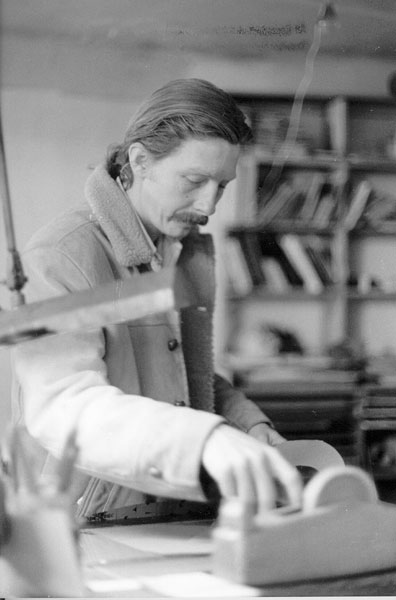
Was Michael McClure still around when you got there, Freeman? Richard Brautigan?
F: Brautigan was more involved on a day-to-day basis. He did this little book ‘Plant This Book’ as sort of a Digger project.
His poem ‘Machines of Loving Grace’ first appears —
F: In the Digger Papers. But he was also a loner.
N: Right. He hung out by himself. What is the word when people just go hang out with poor people?
F: Slumming?
N: Yes. That’s how I think of McClure, hanging out. He was doing a little slumming.
F: Maybe Richard too…?
N: I don’t think Richard so much…
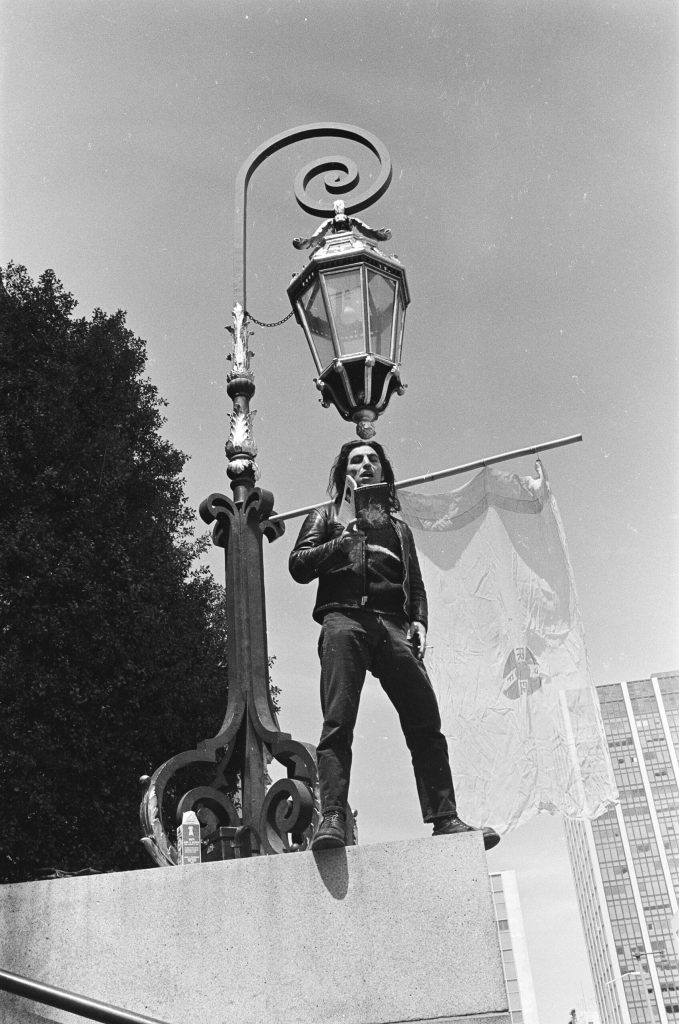
What do you remember about the poetry on the City Hall steps?
F: That went on for something like three months. Everyday, on City Hall steps, it would be, ‘this is a poetry reading.’ It was a wonderful event. Every poet that came through town stopped there and read. People would read right at the lunch hour, when the civic servants were coming in and out. There would always be a big crowd. It was really fun.
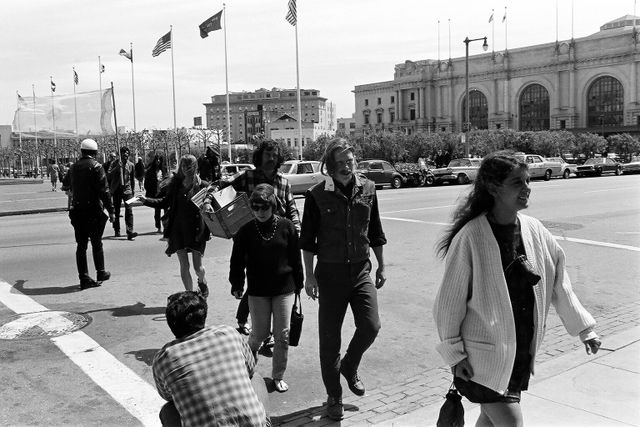
Nina, do you think the huge influx of kids beginning in summer 1967 that ended the Diggers?
N: Emmett got totally freaked out about it. ‘What are we gonna do?’ I remember him freaking out — ‘All these kids are gonna come, how are we gonna take care of them, what are we gonna do about it?’ That was kind of weird. I remember being surprised when Emmett said that, because food was never THAT…. We weren’t… I mean, in my mind, and I was the person who was getting the food and cooking, I didn’t think I had to provide for everybody. The food came out, and there was what there was.
F: The sentiment was, Look, we can take care of ourselves.
N: And so, other people could take care of themselves.
F: I think Emmett was using the Summer of Love as leverage, myself. To make himself an important figure.
N: Oh, in the world?
F: Yeah.
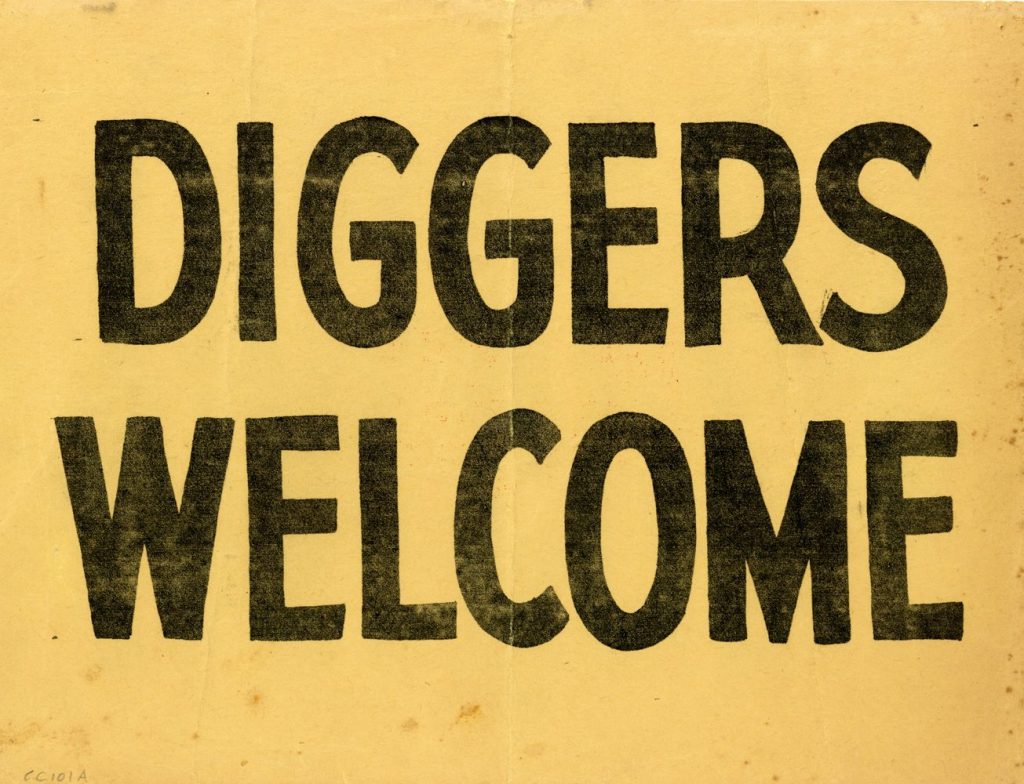
N: I don’t remember the summer of ’67, particularly. Just doing our thing. There was never ever any [rule about] who could come and who couldn’t come, to anything. I mean there was a ‘Diggers Welcome’ sign that went into your [window]. I remember waking up in this house that I lived in with Phyllis and Julie and I went to the kitchen, and I didn’t recognize anybody. [laughter] And they were all talking about how Pisces were fucked up. I’m a Pisces. [laughter]
Was it exhausting?
N: To do the cooking and stuff? No, because it was fun. Everybody did it together. When it got exhausting was when we lived in houses and had children and we actually tried to make real meals, and have food for kids, and support children and do that kind of stuff. And those houses were still totally wide open, anybody could come and show up for dinner and you never knew who you were cooking for.. People would stand around, waiting to see what the kids left. [laughter] But we still had tons of free food. I had people at stores who just let me pick out vegetables. The produce guy at the grocery store would say Okay go to it, and then he’d write “$1” on the box, and I would just fill it up with whatever. And this was just for this house that maybe we had 30 people who lived in it, at different times. And people parked out in front, maybe more. There could be 50-70 people eating dinner there, because they just stopped by. That got exhausting. And I didn’t even realize it was exhausting until we left.
My father thought — because of who my dad was — that it was very sexist. And it really kind of was. If you look at Nowsreal… I was shocked the first time I looked at Nowsreal again, after I don’t know, 15 years? And I was just totally surprised at how it was. I didn’t feel it then. But when I lived in the Red House, which is where Kent and I ended up living, our daughter was born there, it was totally separate: the guys went to the garage and the women were in the house, and we cooked and we cleaned and we took care of the babies. But it was like…tribal. I thought as a young person it was amazing to be able to have a baby at 21 and have a few older women who had had kids already — like Marsha [Thelin] and Judy [Goldhaft], a few different people — to have people around you , as a young mother, who knew what they were doing. We just didn’t really need the guys! [F laughs] They could stay out in the garage. We didn’t care. [laughs] They came in at night.
F: They’d keep the vehicles running.
N: They talked a lot. [laughter] They really didn’t do a good job of keeping the vehicles running. The women did all the work, really.
F: There was usually a vehicle running…
N: But when I left there, when Kent and I left that house, I didn’t want to cook again for a very long time. And then I lived at Turkey Ridge, at Coyote’s. There was much smaller. You couldn’t just decide you were moving in, which was the way it was in the other places. We had cooking days and stuff like that, it was a whole different thing. And that was where you could find out that the break-up of a commune could be just like the break-up of a marriage, multiplied by many more people.
Chuck said he thought there was a distinct end to a certain phase of the Diggers, when Emmett proposed ata meeting doing a free butcher shop and it was shot down.
F: Sounds like that would have been before my time.
N: Would he just be stealing the meat? I have no memory of that one…
I think it was the big drugs that got Emmett. There was the going down to L.A. and hustling people and the 1% free and all that, and a lot of that money went into people’s arms, unfortunately to say. [laughs ruefully] That is a very big thing of it. And then as the L.A. scene got into more of the drugs and the stuff like that… there was just falling in with that group. And then not being anonymous, and not being so totally free. Especially for Emmett. I don’t think Berg was ever very much affected by that. The Hollywood scene.
F: I don’t know. Berg always thought of himself as an actor…
N: Right. So did Emmett.
F: Not a life actor but a stage actor.
N: Emmett was in Olive Pits when I met him.
F: Peter was a brilliant writer at that time. Somewhere along the line he lost it…
N: And Emmett was really good at connecting with people. Moreso than Peter. Peter was harsh.
F: Yeah. Emmett was all charisma.
N: He knew how to make things happen. A lot of people say, and I don’t really know about that, that there’s this story that Billy Murcott is behind a lot of Emmett’s ideas. I don’t know if that’s true or not.
F: I’ve heard that so often.
N: It’s a myth within—
F: Billy is an intellectual. He’s a very mysterious character. He preferred it that way.
N: Some of them had HUGE egos. I mean, Peter Berg terrified me. Kent and I lived with them—
F: Peter Berg inspired me…
N: I know, but you were older and you’re a guy. I was 18 and he was…crazy.
F: Oh, that’s true.
N: I mean, crazy in that brilliant kind of crazy. And the same with Emmett, in a way. I didn’t feel like—
But you and Emmett connected immediately, when you first met him…
N: Yeah, but it was just… He was—
F: Emmett was a very sexy man.
N: And it was his thing. I didn’t really feel like I was his “girlfriend.” It was just…whatever. It was just happening. BUT he was inspiring, too, in his, in their complete craziness. Billy too. Just going out and doing things. Doing whatever. I remember when he was getting his driver’s license, there was this cop who was really an evil cop… Emmett just talked about how he had a license to KILL. [F chuckles]
There was plenty of space for everybody to go and do their own thing. So they didn’t really have to get in each other’s faces.
F: The tension between the men over who owned what didn’t really happen till after the fact. Especially after Emmett wrote his book.
N: With ‘the Hun,’ who was not a very nice character.
F: It’s what everybody called him.
N: The way he portrayed him. I don’t think Peter liked that very much.
There was no leader. I think that’s a very big thing, and that’s why you get all these different stories. There were some very big personalities, but there’s no leader, and it was very consciously like that. And that’s what attracted me to it.
F: It’d be interesting to sit down and make a list of the unspoken ethics of the Diggers. ‘No leaders’ is one thing. Anonymity is a related issue.
N: But just about all the different communes that were going on in the ’60s had leaders.
Chuck said, ‘People will say there were no leaders in the Diggers, but there were.‘
N: There were, but there were many. And they floated in and out of whether they were being a leader at that point. And it was mostly men.
Was Lenore a force, a leader?
N: She was a force, just in her being.
F: Lenore was like a remote goddess. Something somebody sort of…worships. [chuckles]
Peter Berg spoke very affectionately of Lenore.
N: Yeah. Well, she’s had a very hard end of her life. …The whole trip with Bill, and then getting hurt on the motorcycle, and never taking care of it.
People were so young. There’s just that impatience of youth. You think you can do everything, and you also don’t think you’re affected by your growing up at all.
F: You’re also much more susceptible to illusion. Delusion. [laughs]
And so many people seriously thought a revolution was imminent —
N: All over the world.
F: Yeah.
N: I always feel like if I didn’t end up in the Haight-Ashbury—
F: The Sixties always seemed like a separate event to me.
N: I was at Antioch and SDS was really big at Antioch. I always feel like if I hadn’t ended up in San Francisco, I think I might have been a Weatherperson. Which I’m very glad I was kept away from. Bombs. [laughs] But there were all connections. Tons of people came through who were into that. There was no division. I mean, Joanna’s sister was on the run, and Bill and Bernadine were at places.
Freeman, how did you deal with the draft?
N: Asthma.
F: The situation with the draft was, if you’re my age, all the way through high school, that’s all I thought about, was, how you gonna deal with that?
N: That’s the ‘50s.
F: Because once you’re out of high school, you’re free meat. The Army had a come-on called the buddy system, where if you joined with a buddy, you’re guaranteed to serve with that person throughout your two or four-year tour, whatever it was. It was a lie. [laughs]
N: This is pre-Vietnam.
F: A buddy and I went in, tried to join, and they didn’t take me because I had had asthma as a teenager. They took him. Which he never forgave me for. And then I got married, had a kid, I was at school. Thought I was home-free. And the draft notice came. So I went scrambling, trying to find this doctor who had treated me when I had [laughs] asthma. I finally found him. He wrote me a letter. So I got a 4-F. But it was weird, they tried to get me after all that time.
N: Everybody did different things. We had a lot of people, we had people in our houses who were vets back from Vietnam.
F: Or were AWOL.
N: Either way. One way or the other, they were done. But like I said, that was a non-judgement, mostly…
Here’s something I wanted to ask you about. Peter Berg talked about his experience seeing Teatro Campesino at the strike ground. It’s where he really saw the old idea from the labor unions that in providing strike relief, unions were making a vision of what the world to come would look like. We’re going to preview —stage — the coming world. That was his metaphor: the stage.
F: I never heard that story about Peter, that’s very interesting.
N: The Mime Troupe were lefties. And Freeman… I grew up knowing about the Wobblies. And I’m sure Jane did too. Unions were big when I was growing up. That was a big deal.
F: Peter Berg had a further development, what you’re talking about, Peter’s observation of the strike… This always struck me. He had run across somewhere a book on Egyptian ritual theater. He came across a phrase in there, saying that what that theater was, was creating the situation you describe. He always said this. He said that’s what we’re doing, that’s what our theatre was about: creating the situation you describe. The condition.
Did that resonate?
F: Oh very much, yeah. That actually happened to some degree in a larger milieu of society, than just the people who thought of themselves as Diggers. The situation that Nina describes, about clerks and working stiffs on the loading docks giving her food. They knew what they were doing.
N: That check-out guy at the grocery store just said, You have to get some roasts or something. [in voice] Okay!
F: That was only partly because she was such a good looking woman.
N: It was also just because we were always getting lots of food. We were obviously feeding lots of people. So… I guess I followed, I was definitely in the practical part of it. Judy [Goldhaft] was definitely a big mentor of mine in that. Tie-dying: she told you about that, Jodi.
There was a specific woman. Luna…?
N: Same person, she just changed her name. She tie-dyed the way the Balinese or whoever did it, but she changed it and did her own thing. She was a textile artist, and taught us. And we tie-dyed, Judy and I tie-dyed together huge amounts of stuff. Some of them were horrible mistakes, where we had the wrong dye. We tie-dyed this tent once for something, and we had the wrong kind of dyes and nothing stuck. Nothing dyed. We probably spent days and days.
And before the seder, we must have cooked for a week. That’s a practical part of the whole thing. Religious Jews get rid of all the food in their house before Passover, so we got all of that, from the temples. [laughs] That [seder] quite an intense scene. Ginsberg was there.
F: Ginsberg conducted the seder, as I remember it.
Ginsberg adored the Diggers, he talked you up all the time in interviews from that period. He had great hopes that the Diggers’ example —
N: Kent and I were in New York, Kent was in a [Mime Troupe] show called L’Amant Militaire, which toured for a long time. We were in New York for about a month. It was an unusual thing where we actually just stayed somewhere. In a theater, rather than be an outdoor show and all that. And stayed in the house where Peter Orlovsky’s brother stayed. So they used to come over all the time, Peter and Allen. And tons of other people. All these scenes were going on everywhere. Not just Diggers.
Freeman, you were talking about your interest in anarchism. What do you think the Diggers were up to? Was it an anarchist thing, at heart?
F: Well… I think it might have been stifling to call what we were doing ‘anarchism’ at the time [chuckles], just because anarchists are horrible ideologues and sit around and argue ideology all day. If you used the word at the time, it was to indicate an attitude about life, freedom… But it wasn’t political anarchism. What it was for me was a demonstration that anarchism could work. But I don’t think that was a common goal—it wasn’t even my goal, it was just what was happening. It was an observation. In any system of anarchism, you’ve always got the bad guy, the greedy person is gonna show up and what is there to stop him? Who’s going to make the rules? Where do the rules come from? [Later on] it was such a revelation to me that the rules are already there, in nature. I mean, there’s boundaries you cannot exceed. Unfortunately, we have.

 Diggers Docs